Application Encryption
HSM-Backed Cryptographic Services for Application Encryption Across Any Application Stack
CryptoHub delivers FIPS 140-3 Level 3 cryptographic key management and encryption operations to applications through PKCS #11, KMIP, Microsoft CNG, JCE, and OpenSSL, with integration engineering for environments that need custom connectors. Development teams own application business logic. The security team owns key policy, lifecycle, and audit. One platform holds both.
.png?width=770&height=770&name=Application%20Encryption%20Hero%20Image%20(1).png)
Five standard cryptographic interfaces: PKCS #11, KMIP, Microsoft CNG, JCE, and OpenSSL provider

Application field-level and object-level encryption with per-field key policy and access controls

Centralized cryptographic key lifecycle: rotation, revocation, and expiration managed in CryptoHub, not in application code

Crypto-agility: update cryptographic algorithms and key lengths across all connected applications without code changes

Deployable as an on-premises hardware appliance, virtual appliance, or CryptoHub Cloud (SaaS)
What Is Application Encryption?
Application encryption integrates cryptographic application operations directly into application workflows, protecting individual fields, records, messages, or data objects at the point where the application creates or processes them. It complements database-level and storage-level encryption by adding cryptographic key-level granularity and auditability where it matters most. If your team already knows the category, the question is how to implement it without pushing key management into application code - that is what this page addresses.
How Does CryptoHub Deliver Application Encryption?
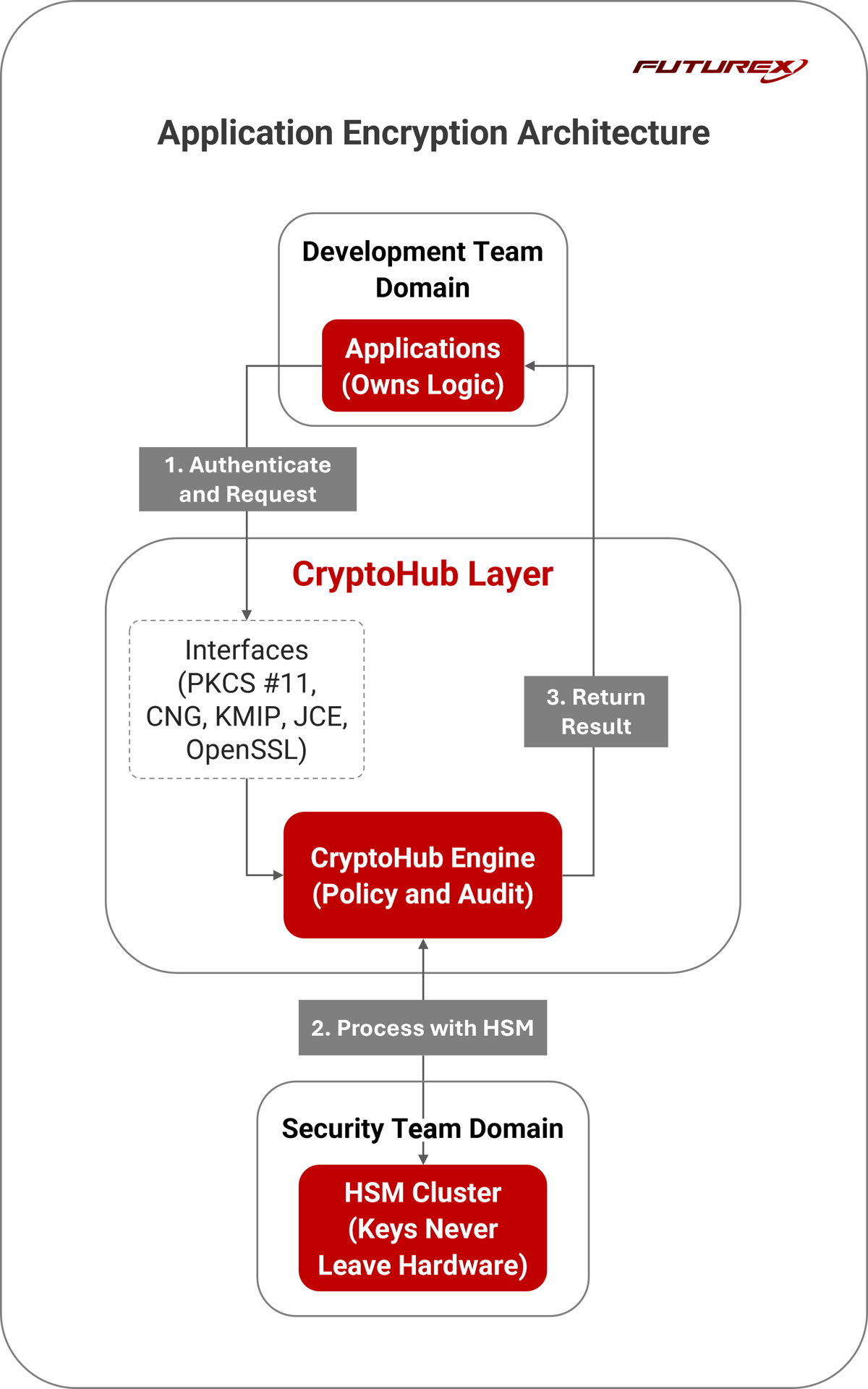
CryptoHub operates as a centralized cryptographic services layer. Applications authenticate to CryptoHub and request cryptographic operations through a supported interface. CryptoHub processes each request using HSM-backed key material and returns the result. Cryptographic keys are generated and protected within the HSM hardware and never appear in application code, configuration files, or local key stores.
The security team manages key policy, access control, and lifecycle in CryptoHub. Development teams own application logic and determine what gets encrypted and when. A cryptographic key rotation or algorithm update in CryptoHub propagates to all connected applications without requiring changes to application code.
What Interfaces Does CryptoHub Support?
The table below maps each supported cryptographic interface to its typical environment and integration pattern. For applications that do not natively expose a standard interface, Futurex integration engineering builds the connector, and additional platforms and environments are supported through that process.
| Interface | Environments and Frameworks | Common Integration Pattern |
| PKCS #11 | C/C++, Python, Java, OpenSSL, middleware | Broad application and middleware integration; most widely supported HSM interface |
| Microsoft CNG | Windows, .NET, IIS, Windows enterprise software | Backs Windows cryptographic calls with HSM key material; drop-in CNG provider |
| KMIP | Heterogeneous environments, multi-vendor key management architectures | Centralized key lifecycle management across platforms with KMIP client support |
| JCE | Java enterprise, application servers, JVM-based frameworks | Drop-in JCE provider for existing Java cryptographic calls |
| OpenSSL Provider | OpenSSL-dependent applications, Linux/Unix environments | Directs OpenSSL cryptographic calls to HSM-backed key material |
| Integration Engineering | Proprietary and legacy systems without standard interface support | Custom connector development, adapter design, integration testing, deployment support |
Why Crypto-Agility Matters for Application Encryption
Applications that handle their own cryptographic operations become a liability when algorithm standards change. Updating from SHA-1, retiring 1024-bit RSA keys, or migrating to post-quantum algorithms requires locating every place cryptography is implemented and updating each one individually. That is a coordinated engineering project across every team that owns an application.
CryptoHub centralizes algorithm selection and key policy. When standards change, the security team updates configuration in CryptoHub. Connected applications inherit the change without a code release. This is the operational foundation for post-quantum migration planning: the transition timeline may be uncertain, but the readiness posture is not.
Because NIST post-quantum algorithm standards are now finalized, the migration question is no longer whether, but when and how. Organizations that have centralized cryptographic algorithm policies in CryptoHub can respond to that timeline without a coordinated application-level rewrite.
CryptoHub Advantages for Application Encryption
Most organizations reach a point where application encryption cryptographic keys are scattered: some in environment variables, some in application configuration files, some in a secrets management tool, some in a homegrown key store. Each of these introduces audit gaps, rotation complexity, and key exposure risk.
CryptoHub consolidates application encryption key management onto a single platform backed by FIPS 140-3 Level 3 HSMs. The same platform managing application encryption keys also manages TLS certificates, database encryption keys, payment HSM key material, and code signing keys. Security teams manage policy in one place. Development teams integrate through standard interfaces. Audit logs for all application cryptographic operations and key lifecycle events are centralized and consistent.
This is not a trade-off between security and operational simplicity, it is the removal of the trade-off.
Application Encryption Compliance Support
PCI DSS
Application field-level encryption of PANs, track data, and sensitive cardholder data at the application layer supports PCI DSS P2PE and point-of-interaction encryption requirements. HSM-backed key management provides the documented key protection evidence required for assessments.
HIPAA
Application field-level protection of ePHI in EHR, clinical, and health data applications, with documented key management, satisfies HIPAA encryption requirements. Audit logging in CryptoHub provides the key access records assessors require.
Governance and audit
Role-based access control, separation of duties between development and security teams, and comprehensive application cryptographic operations and key management activities support internal governance frameworks and external audit requirements across verticals.
Application Encryption Use Cases
Payment applications
Encrypt PANs, track data, and sensitive cardholder fields at the application layer. Meet PCI DSS P2PE and point-of-interaction encryption requirements with documented HSM-backed key management and field-level key policy.

Healthcare applications
Protect ePHI at the field level in EHR and clinical applications. Satisfy HIPAA encryption requirements with key management documentation that meets assessor standards.
Java enterprise applications (JCE)
Integrate application-layer encryption into Java-based enterprise software, application servers, and JVM-based frameworks without replacing existing cryptographic call patterns. CryptoHub acts as the JCE provider.

.NET and Windows applications (CNG)
Connect Windows-native application encryption to CryptoHub key management through the Microsoft CNG interface. Supports IIS, .NET applications, and Windows-based enterprise software.

Middleware and integration platforms
Connect application cryptographic services to ESB, integration platforms, and middleware that expose PKCS #11 or KMIP integration points.

Custom and legacy enterprise applications
Encrypt sensitive fields in internal enterprise applications without building or managing key infrastructure. For applications without native standard interface support, Futurex integration engineering develops the connector, tests the integration, and supports deployment. Additional environments supported through the same process.

Deployment models
CryptoHub is available in three deployment models. The model for the application cryptographic services layer is independent of the applications connecting to it, a migration from on-premises to cloud-hosted infrastructure does not require re-architecting application encryption.
On-Premises Appliance
CryptoHub deployed in your data center on dedicated Futurex hardware. HSMs providing key protection are co-located with the CryptoHub instance. Preferred for organizations with data residency requirements or air-gapped environments.

Virtual / Hybrid Appliance
CryptoHub deployed as a virtual machine in your private cloud or virtualized infrastructure. Supports the same interface set as the hardware appliance. Suitable for organizations running workloads in VMware, KVM, or private cloud environments.

CryptoHub Cloud (SaaS)
Futurex-managed cloud deployment with HSM-backed key protection in a Futurex-operated facility. Reduces infrastructure overhead while maintaining FIPS 140-3 Level 3 validated key protection. Suitable for organizations that want to avoid on-premises HSM management without compromising on hardware-backed key security.
Frequently Asked Questions
What interfaces does CryptoHub support?
CryptoHub supports PKCS #11, Microsoft CNG, KMIP, JCE, and OpenSSL provider interfaces. These cover the dominant application integration patterns for C/C++, Java, .NET, Python, and other enterprise development environments. For enterprise applications that do not expose a standard interface, Futurex provides integration engineering to build the connector.
Does CryptoHub support field-level encryption?
Yes. Applications connecting through PKCS #11 or KMIP can request encryption of individual fields or data objects. The application controls which fields are encrypted and when. CryptoHub manages the associated key material and returns the result. Different fields can use different keys and different access policies.
How does key rotation work for connected applications?
Key rotation is configured and executed in CryptoHub by the security team. Applications request cryptographic operations using a key identifier; CryptoHub resolves the current active key. Application code does not change during a rotation. Rotation can be scheduled by policy or triggered manually.
What deployment options are available?
Yes. CryptoHub is available as an on-premises hardware appliance, a virtual appliance for private cloud environments, and as CryptoHub Cloud - a Futurex-managed SaaS deployment with HSM-backed key protection. The deployment model can be selected or changed independently of the applications connecting to it.
Does CryptoHub support multi-tenant deployments?
Yes. CryptoHub supports logical separation of cryptographic key material and access policies for multi-tenant environments. Each tenant's key material can be isolated within a separate partition or policy domain, with independent access controls and audit logs.
How long does integration take?
Integration timelines vary by interface and application architecture. Applications with native PKCS #11, KMIP, JCE, or CNG support can typically complete integration in days to weeks. Custom connector development for proprietary or legacy systems requires a scoping conversation to estimate. Futurex provides integration engineering support throughout.
How does CryptoHub support post-quantum migration?
Cryptographic algorithm selection and key policy are centralized in CryptoHub rather than embedded in application code. Transitioning connected applications to post-quantum algorithms requires configuration changes in CryptoHub, not code changes in individual applications. This positions organizations to respond to NIST post-quantum standards on a defined timeline without a coordinated application code migration.
Featured Resources
"By deploying Futurex devices, Ecentric will be the first payments provider in Africa to deploy ‘point-to-point’ encryption (P2PE), thereby establishing the strongest protection possible... P2PE will provide a competitive advantage and is a major step forward in assisting our customers..."
- Hassen Sheik, CEO
Ecentric
Plan Your Application Encryption Integration Path
Build Your HSM, Your Way.
CryptoHub delivers HSM-backed cryptographic services to applications through PKCS #11, KMIP, Microsoft CNG, JCE, and OpenSSL - with centralized key lifecycle management and integration engineering for environments that need custom connectors. Available on-premises, as a virtual appliance, or as CryptoHub Cloud.
The first step is identifying where your application cryptography lives today and where key management responsibility should sit. We can walk through that with you. Start for Free.
Explore Related Solutions
Data Protection → |Enterprise Key Management → | Payment HSM → | Code Signing →