by
 David Close, Chief Solutions Architect
Last updated: June 9, 2026


For years, post-quantum cryptography looked like a staged transition. NIST would publish standards. Hardware Security Module (HSM) manufacturers would add support for PQC. Organizations would replace outdated systems over the next hardware cycle, with much of the pressure landing in the 2030s. That timeline made PQC feel important, but not immediate.
Now that timeline is beginning to compress.
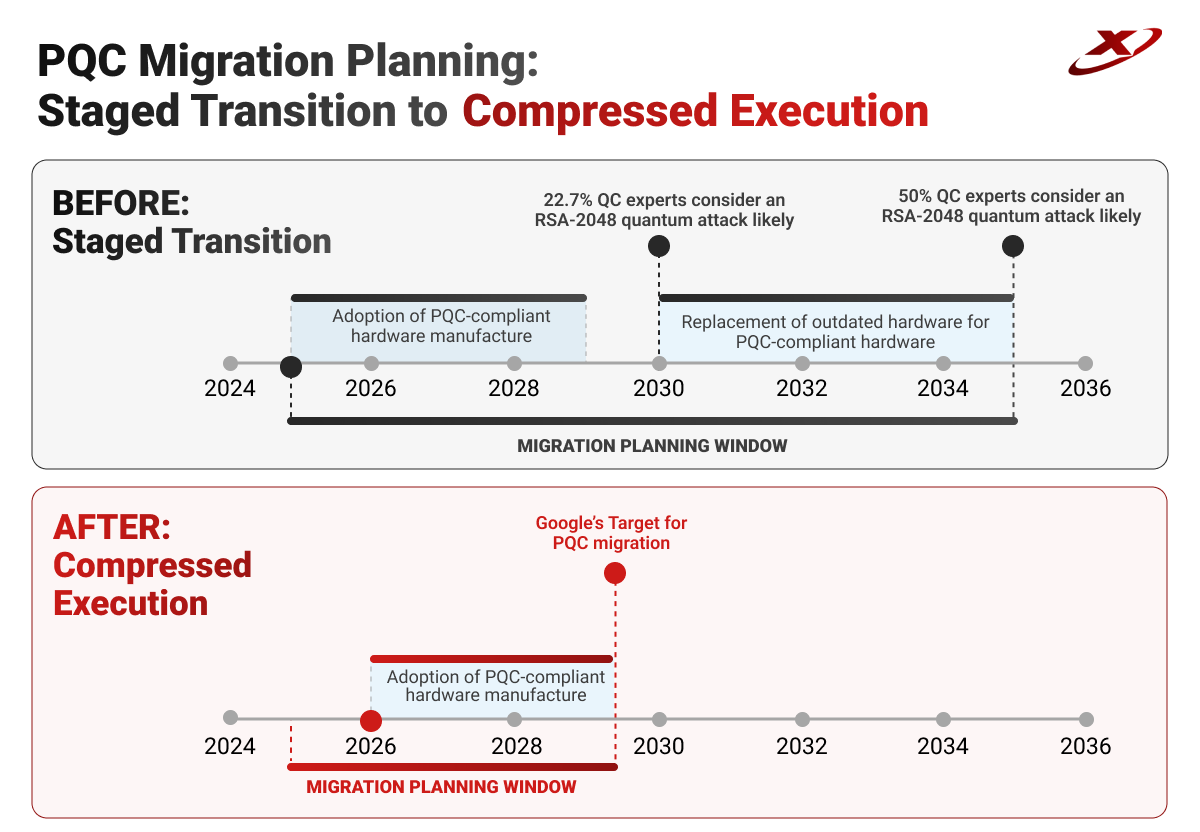
Google has set 2029 as its target for PQC migration, citing progress in quantum hardware, quantum error correction, and resource estimates for quantum factoring. Google is not claiming that quantum computers will break RSA in 2029.
Instead, the target reflects growing confidence that organizations should prepare for PQC migration sooner than many teams originally planned.
That changes the work ahead.
Organizations now need to identify where RSA and ECC still support key establishment, digital signatures, certificates, authentication, firmware updates, and long-lived encrypted data. “Harvest Now, and Decrypt Later” risk already affects data with long-term value. Digital signature and authentication systems need migration plans before a cryptographically relevant quantum computer exists.
That is why the first step is clarity: knowing which NIST PQC standard applies to which cryptographic function.
The NIST (National Institute of Standards and Technology) has finalized three PQC standards: FIPS 203 ML-KEM, FIPS 204 ML-DSA, and FIPS 205 SLH-DSA. These standards provide the foundation for migrating systems to quantum-resistant cryptography.
- FIPS 203 ML-KEM is a module lattice-based key encapsulation mechanism used for key establishment
- FIPS 204 ML-DSA is a lattice-based digital signature standard.
- FIPS 205 SLH-DSA is a stateless hash-based signature standard.
Adopting these standards isn't just future-proofing your systems; it's crucial for maintaining robust security today.
While quantum computing is in its infancy, the threats it poses, such as 'Harvest Now, Decrypt Later' (HN/DL) attacks, are both significant and imminent. Embracing these new standards ensures your data remains secure today and in the future.
Use Cases: Real-World Applications of PQC
PQC is important for systems that depend on public-key cryptography across sectors such as financial services, healthcare, government, defense, and aerospace.
Satellites In Space

Imagine a satellite launched into orbit with a 20-year lifespan, initially protected by conventional public-key cryptography such as ECC.
As quantum computing progresses, the public-key cryptography used for key establishment and signatures could become vulnerable.
In a typical public-key encryption use case, the public key encrypts data or a shared secret, and the private key decrypts or derives the corresponding secret.
Code signing uses a private key to create a digital signature, and a public key to verify it. Verification confirms authenticity and integrity.
For PQC, ML-KEM replaces RSA/ECC for key establishment, while ML-DSA and SLH-DSA replace RSA/ECC for digital signatures and code signing.
When the satellite receives a firmware update, it verifies the signature before installing it. With a hybrid CA structure, the satellite’s firmware can transition to PQC-enabled certificate validation without physical intervention.
Mission Control can send an update signed with a PQC signature scheme, maintaining security without interruption. This approach applies to long-lived devices that rely on firmware authenticity and key establishment lifecycles.
Harvest Now, Decrypt Later (HNDL)
The growing adoption of PQC is driven in part by ‘Harvest Now, Decrypt Later’ risk. In these attacks, adversaries collect encrypted data now, expecting that future quantum computers may be able to decrypt it.
By migrating to PQC, organizations can reduce exposure to future quantum-enabled decryption risks.
Hybrid Model
“Futurex’s approach to PQC is built into its HSM platform, enabling tighter integration and optimization.
A hybrid Certificate Authority (CA) approach can combine conventional and PQC signatures or trust anchors during migration. This approach helps systems remain compatible during migration while preparing for quantum-resistant cryptography.
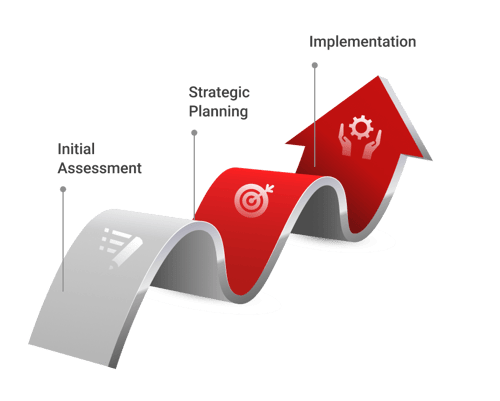
Migration should be planned and phased, with vulnerable algorithms prioritized first.
Future-Proof PQC with Futurex

As cryptography evolves, so does Futurex. NIST has selected Falcon for ongoing standardization as an additional digital signature scheme, and CryptoHub is being prepared to support it. Stay ahead of adversaries who may collect encrypted data today and attempt to decrypt it later.
By implementing PQC now, you reduce the risk that harvested data can be decrypted later.
Whether securing a satellite in space or supporting enterprise authentication, PQC is becoming a necessary part of cryptographic migration. Futurex is here to help lead the way.
The transition to post-quantum cryptography is a necessary part of long-term cryptographic planning.
As quantum computing advances, cryptographic systems must evolve. Futurex’s CryptoHub platform integrates NIST PQC standards to support migration planning.
Speak with Futurex today to implement PQC solutions to secure your systems against tomorrow’s quantum challenges.
Webinar: Future-Proof Your Security: Actionable Quantum-Safe Solutions