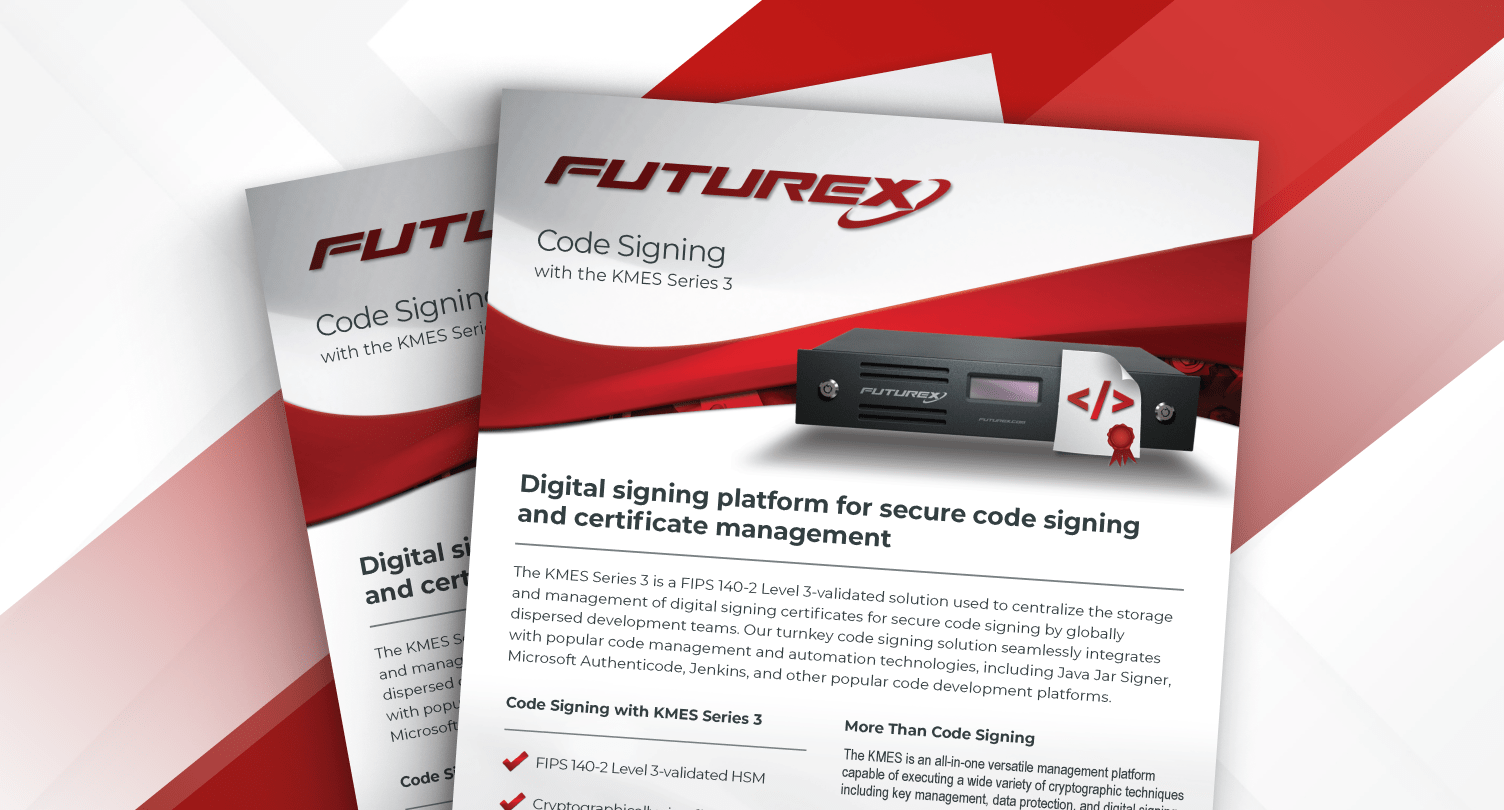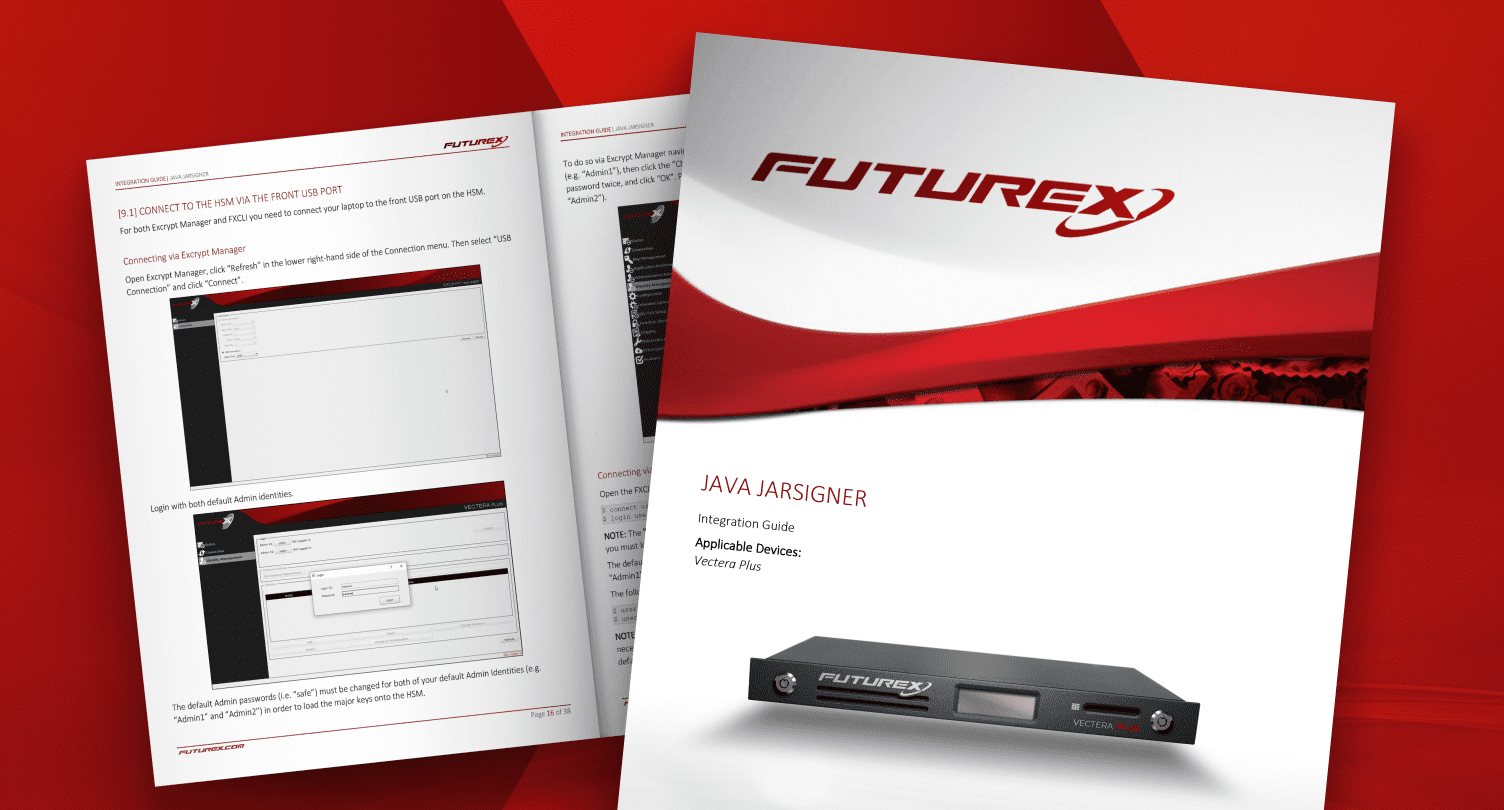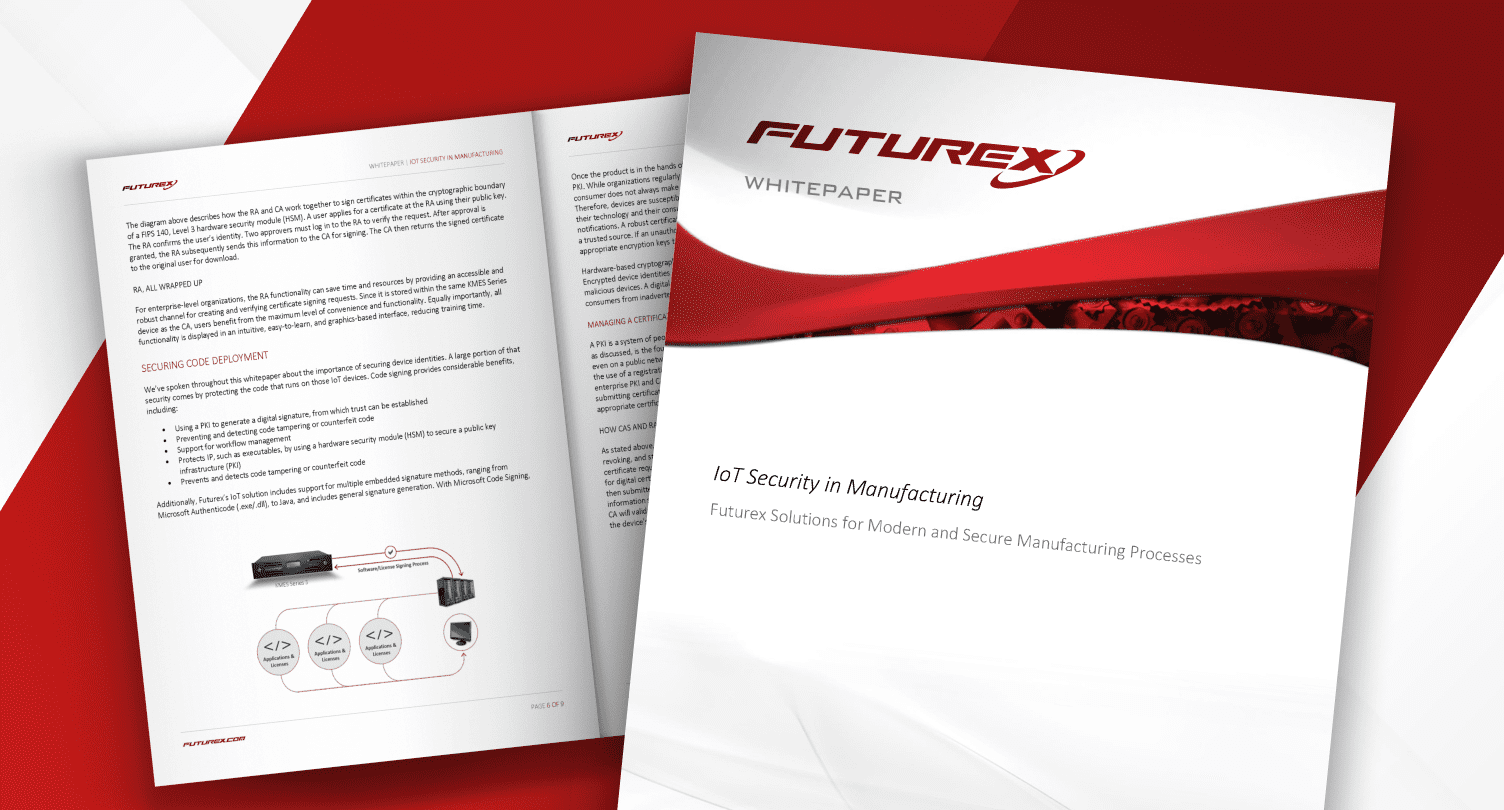

Code Signing
Issue and manage code signing certificates with HSM-backed key protection, automated signing workflows, and controlled trust validation across software development and distribution environments.
Code Signing CA
Issue and manage code signing certificates with HSM-backed key protection, automated signing workflows, and controlled trust validation across software development and distribution environments.
140-3 Level 3 validated HSM protection

Automated certificate issuance and signing workflows

GitLab CI/CD and Jenkins integration via CLI or API
CRL and OCSP support for certificate status validation
What Is Code Signing?
Code Signing issues and manages the certificates used to sign software, scripts, packages, and updates.
It gives development and security teams a controlled way to validate publisher identity, protect signing keys, apply digital signatures, and verify software integrity from build through distribution.
Teams can use it to:
- Process certificate signing requests through defined validation workflows
- Issue code signing certificates for approved developers, teams, and services
- Protect private signing keys inside HSM-backed hardware
- Apply digital signatures through command line tools and automated build workflows
- Distribute trust chains and revocation data to dependent systems
- Track certificate status, renewal, and lifecycle events for audit review
Futurex delivers a smarter approach to Code Signing with a unified platform designed for modern scalability, operational simplicity, and cryptographic agility.
Why Futurex for Code Signing?
Code signing is often spread across certificate teams, build systems, private key management, release pipelines, and separate trust services.
In many enterprise environments, signing keys are managed outside protected hardware. Build teams to control certificates that IT and security teams do not fully track. Release teams can sign software without a central audit record showing what was signed, which certificate was used, who approved the action, or when the signing event occurred.
The result is a code signing process that works operationally but lacks centralized control. Teams can ship signed software, but security leaders have limited visibility into key areas such as custody, certificate ownership, signing activity, and certificate status across development and distribution workflows.
Futurex CryptoHub brings together code signing certificate issuance, HSM-backed key protection, digital signature workflows, and trust chain validation into a single, controlled operating model. Teams can process requests, issue certificates, protect signing keys in hardware, automate signing in GitLab CI/CD and Jenkins workflows through CLI or API integration, validate certificate chains, and track lifecycle activity across development and distribution environments.
While fragmented tools force teams to reconcile signing activity across separate systems, Futurex provides a direct path from certificate issuance to software distribution, with policy enforcement, hardware-backed key control, and documented signing events.
Code Signing Workflow
Enterprise code signing programs often support multiple artifact types. Security and release teams may need signing controls for Windows Authenticode, Linux kernel modules, firmware updates, container images, and macOS applications.
Each scenario has a different toolchain, release owner, certificate usage pattern, and validation path. Futurex gives teams a consistent control layer for certificate issuance, signing key protection, approval workflows, and audit records across these signing contexts.
Common signing scenarios include:
- Windows Authenticode signing for executables, installers, drivers, and scripts
- Linux kernel module signing for approved modules loaded by protected Linux systems
- Firmware signing for embedded devices, appliances, and update packages
- Container image signing for images promoted through registries and deployment pipelines
- macOS code signing for applications, packages, and internal developer workflows
Certificate Request and Approval
Certificate signing requests move through defined validation and policy checks before issuance.
Certificate Issuance
An issuing CA signs and issues code signing certificates for approved software publishers, development teams, or automated services.
Private Key Protection
Private signing keys remain inside tamper-resistant HSM-backed hardware with role-based access controls for sensitive operations.
Signing Operations
Developers and automated pipelines apply digital signatures through CryptoHub CLI or API integration with release workflows, including GitLab CI/CD and Jenkins pipelines.

Trust Validation and Distribution
Signed software can be validated through certificate chain checks, trust store distribution, and certificate status checks through CRL and OCSP.
Renewal and Revocation
Expiration monitoring, renewal workflows, and revocation tracking help maintain release trust and certificate control over time.
Challenges in Managing Code Signing at Enterprise Scale
Organizations often run into problems such as:
- Private signing keys handled outside protected hardware
- Manual signing steps across build and release teams
- Certificate approvals managed through email, tickets, or disconnected tools
- Logging spread across CA systems, build tools, and release infrastructure
- Revocation and status updates that lag behind release activity
- Different signing controls across Windows, Linux, macOS, and open-source tooling
These issues grow when code signing spans CI/CD pipelines, build systems, PKI infrastructure, operating system trust stores, and release teams.
Futurex gives teams a single operating model for code signing certificate issuance, HSM-backed key custody, signing workflow integration, and certificate status control across complex software delivery environments.
Crypto-Agility for Code Signing Operations
Code signing programs need more than certificate renewal. They need a way to update signing policies, introduce new cryptographic standards, and stage signing changes across release workflows without rebuilding the process around each transition.
Futurex supports algorithm agility for code signing operations with certificate policy enforcement, migration planning, and support for current and future cryptographic standards. That gives security and development teams a controlled path for adapting signing operations as requirements change.
Hardware Root of Trust for Code Signing Keys
Code signing keys must remain protected at the same level as the software trust they establish.
Futurex uses an HSM-backed architecture with FIPS 140-3 Level 3 to protect code signing keys within tamper-resistant hardware. That hardware root of trust supports private key storage, signing operations, access control, and documented certificate activity across the signing lifecycle.
For teams working against public code signing and EV-style key-protection requirements, the hardware level matters. The CA/Browser Forum Code Signing Baseline Requirements require code signing subscriber private keys to be protected in hardware crypto modules that meet at least FIPS 140-2 Level 2 or Common Criteria EAL 4+. Microsoft UEFI signing requirements also reference private key protection in a hardware cryptography module with security at least equal to FIPS 140-2 Level 2.
Futurex HSM-backed architecture, with FIPS 140-3 Level 3, is designed to exceed that Level 2 hardware baseline while giving enterprises centralized control over signing key custody, certificate use, and audit records.
Hardware-backed protection gives teams:
- Protected private key storage
- Controlled signing operations inside hardware
- Role-based access controls for sensitive actions
- Logging for certificate and signing events
- Stronger separation between certificate issuance and software release use
Code Signing Capabilities
Certificate Request and Issuance Control
Process CSRs, apply certificate policies, issue code signing certificates, and manage signed certificate distribution through defined workflows.

HSM-Backed Signing Operations
Protect code signing keys in hardware and apply digital signatures without exposing private keys to general-purpose systems.
Developer and Pipeline Integration
Connect CryptoHub to GitLab CI/CD and Jenkins via CLI or API, enabling approved signing actions to run within existing release workflows without moving signing keys outside protected hardware.
Trust Chain and Status Validation
Support certificate chain validation, trust store distribution, CRL management, and OCSP-based status checking.

Audit Trails and Access Control
Track code signing operations and certificate lifecycle events with role-based permissions and multi-factor authentication for sensitive actions.
Certificate Lifecycle Management
Monitor expiration dates, automate renewal workflows, and maintain revocation records tied to certificate status and release trust.
Code Signing Architecture
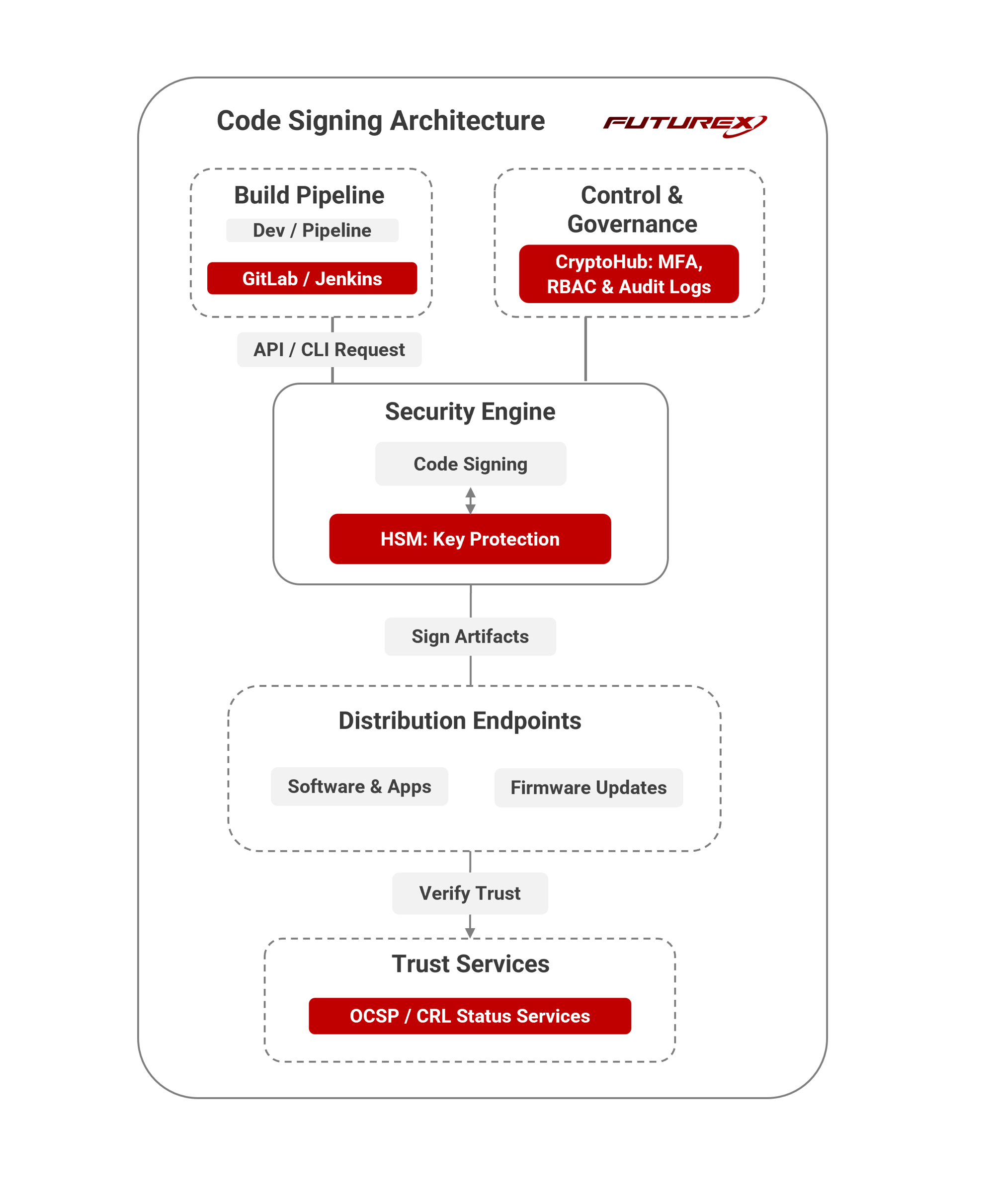
Code Signing fits into enterprise PKI and software delivery infrastructure as the control layer for certificate issuance, signing key protection, and trust validation.
A typical architecture includes:
- Code Signing for request processing and certificate issuance
- HSM-backed private key protection and signing operations, with FIPS 140-3 Level 3
- CryptoHub CLI and API integration for developer and automation workflows
- GitLab CI/CD and Jenkins pipelines that trigger approved signing actions
- CI/CD and version control systems that trigger signing actions
- Root and subordinate CA relationships that support the trust chain
- CRL and OCSP services for certificate status checking
- Audit logging, role-based permissions, and MFA for operational control
This architecture gives teams a controlled path from certificate issuance to software distribution without splitting trust operations across separate point tools.
Integrations
Code Signing integrates with the systems that request, consume, apply, and validate software signing certificates.
Development and Release Systems
- GitLab CI/CD pipelines
- Jenkins pipelines
- Command line signing workflows
- API-driven signing workflows
- Version control and release-triggered signing workflows
- Open-source development environments
Operating Environments
- Windows
- Linux
- macOS
PKI and Trust Services
- PKI infrastructure
- Issuing CA workflows
- Root and subordinate CA hierarchies
- X.509 certificate workflows
- CRL and OCSP services
- Active Directory
- Windows Server
These integration points help teams apply consistent signing and trust controls across software release operations.
Compliance Support
Code Signing helps teams document who requested a certificate, how it was approved, which signing key was used, when a certificate was renewed or revoked, and how status data was published.
Futurex supports audit logging for code signing operations, certificate lifecycle event tracking, role-based permissions, multi-factor authentication for sensitive actions, and status controls through CRL and OCSP.
For regulated software environments, that creates clearer evidence of key custody, certificate status, and signing activity across the release process.
Code Signing FAQ
Should I use an OV/EV certificate from a commercial CA or run my own Code Signing?
The choice depends on the distribution scope. For software distributed to external users, teams typically need a certificate that chains to a public trust anchor recognized by the target operating system, browser, or application environment. OV and EV code signing certificates from commercial CAs support public trust model.
For internal software distribution, firmware updates, enterprise tooling, and controlled development environments, private Code Signing gives the organization direct control over issuance, renewal, revocation, certificate policy, and signing key custody. It also avoids recurring commercial CA purchases for internal signing certificates.
Futurex is positioned for organizations that need private code signing control across internal software, firmware, and enterprise release workflows, with HSM-backed key protection and centralized audit records for signing activity.
How does Futurex protect code signing keys?
Futurex protects code signing keys inside 140-3 Level 3 validated HSMs. That keeps private signing keys inside tamper-resistant hardware during storage and signing operations.
How does it fit into CI/CD workflows?
Futurex CryptoHub integrates with GitLab CI/CD and Jenkins through CLI or API calls. That lets teams trigger approved signing actions inside existing release pipelines while keeping signing keys protected in HSM-backed hardware.
How are revoked or expired certificates handled?
Futurex supports expiration monitoring, renewal workflows, revocation tracking, CRL distribution, and OCSP-based status checking. That helps teams maintain current certificate status across signing operations and trust validation.
How is this different from a general issuing CA?
A general issuing CA handles certificate issuance across many use cases. Code Signing focuses the certificate workflow on software signing operations, private key custody, developer and pipeline integration, and trust validation across software distribution.
Featured Resources
"Customized remote key loading solution for worldwide ATM manufacturing organization implemented in less than two months to comply with encryption standards."
- Nautilus Hyosung Case Study
Strengthen Code Signing Operations
Manual code signing creates release friction, weak key custody, and audit gaps across software development and distribution workflows. Futurex Code Signing provides the control, protection, and certificate workflow automation required to manage software signing operations at enterprise scale.