
Skip to content
Futurex Tops ABI Competitive Report as #1 Innovator!
  • There are no suggestions because the search field is empty.
Futurex Tops ABI Competitive Report as #1 Innovator!

IoT CA

Automate device certificate issuance, renewal, revocation, and trust-chain management across manufacturing, provisioning, and deployed IoT environments.

IOT_CA_Header_Image_1-removebg-preview
HSM-backed CA key protection

HSM-backed CA key protection

Automated device certificate issuance and CSR processing

Automated device certificate issuance and CSR processing

Manufacturing and deployment lifecycle workflows
Manufacturing and deployment lifecycle workflows

X.509, TLS, CRL, and OCSP support

X.509, TLS, CRL, and OCSP support

What Is IoT CA?

IoT CA provides centralized certificate authority operations for connected devices.

It allows security, product, and manufacturing teams to issue device identities, manage trust chains, and track certificate status from factory provisioning through field deployment.

Teams can use it to:

  • Process certificate signing requests for device enrollment
  • Provision X.509 certificates during manufacturing and registration
  • Establish trust through root, subordinate, and issuing CA relationships
  • Renew, replace, and revoke device certificates across deployed fleets
  • Validate certificate status through CRL and OCSP workflows
  • Document certificate events for operational review and audit support
What Is IoT CA graphic showing devices being encrypted by Futurex

Why Futurex for IoT CA?

Device certificate operations often span production lines, provisioning tools, CA servers, IoT platforms, gateways, trust stores, and field-service workflows.

That fragmented model creates inconsistent certificate handling, delayed renewal, weak revocation response, and audit records scattered across separate systems. It also raises risk when CA private keys and signing operations are managed outside tamper-resistant hardware.

Futurex brings IoT certificate operations into an HSM-backed control model and positions IoT CA within the CryptoHub ecosystem. Teams can automate device certificate issuance, certificate policy enforcement, trust-chain management, and lifecycle events across manufacturing and deployed environments.

While fragmented tools force teams to reconcile certificate status across separate systems, Futurex gives organizations a controlled way to issue device certificates, protect CA private keys, and maintain trust across connected deployments.

IoT Device Certificate Lifecycle

Futurex applies certificate lifecycle control across the device journey, from manufacturing enrollment through certificate renewal, revocation, and replacement. IoT CA tracks expiration, manages renewal workflows, handles revocation, replaces certificates across deployed device populations, and supports over-the-air renewal when field environments require remote updates. 

Manufacturing Enrollment

Manufacturing Enrollment

Production workflows can accept device certificate requests, apply certificate policy, and provision certificates as devices move through build, staging, and provisioning steps.

Certificate Issuance and Identity Establishment

Certificate Issuance and Identity Establishment

IoT CA can issue end-entity X.509 certificates, bind device identities to trusted CA hierarchies, and support authentication workflows for connected devices and gateways.

Deployment and Trust Distribution

Deployment and Trust Distribution

Teams can distribute certificate chains and trust anchors to the systems that validate device identities, including IoT platforms, gateways, and enterprise applications.

Challenges in Managing IoT Certificates at Enterprise Scale

Organizations managing connected devices at scale often face:

  • Manual CSR handling across factories and provisioning systems
  • Inconsistent certificate injection across production environments
  • Separate administration of root, subordinate, and issuing CAs
  • Delayed replacement of expiring device certificates
  • Trust store drift across gateways, platforms, and devices
  • Weak revocation response across distributed deployments
  • Certificate records split across manufacturing, PKI, and operations teams

These problems grow when device identity depends on separate CA tools, provisioning scripts, trust stores, and manual coordination between security and manufacturing teams.

Futurex reduces that operational sprawl by centralizing certificate workflows in an HSM-backed platform. That gives teams one operating model for issuance, lifecycle control, certificate status, and audit documentation across connected device environments.


Crypto-Agility for Long-Life IoT Deployments

Many connected devices stay in service far longer than the cryptographic assumptions present at manufacturing time.

That makes crypto-agility an operational requirement. Teams need a way to update certificate policy, introduce new algorithms, and stage migration plans without rebuilding device identity workflows for each product line or deployment model.

Futurex supports that transition by keeping certificate operations centralized. Security teams can manage current certificate workflows and prepare for future cryptographic migrations through the same control model used for issuance, renewal, and revocation.

For long-life IoT deployments, that matters in four areas:

Ongoing trust management as certificate standards change
Policy updates across existing device populations

Policy updates across existing device populations

Staged migration planning for new cryptographic requirements

Staged migration planning for new cryptographic requirements

Controlled certificate replacement across field deployments

Controlled certificate replacement across field deployments

Ongoing trust management as certificate standards change
Ongoing trust management as certificate standards change

Hardware Root of Trust for Device Certificate Operations

IoT certificate operations depend on the protection of CA private keys, signing keys, and certificate authority workflows.

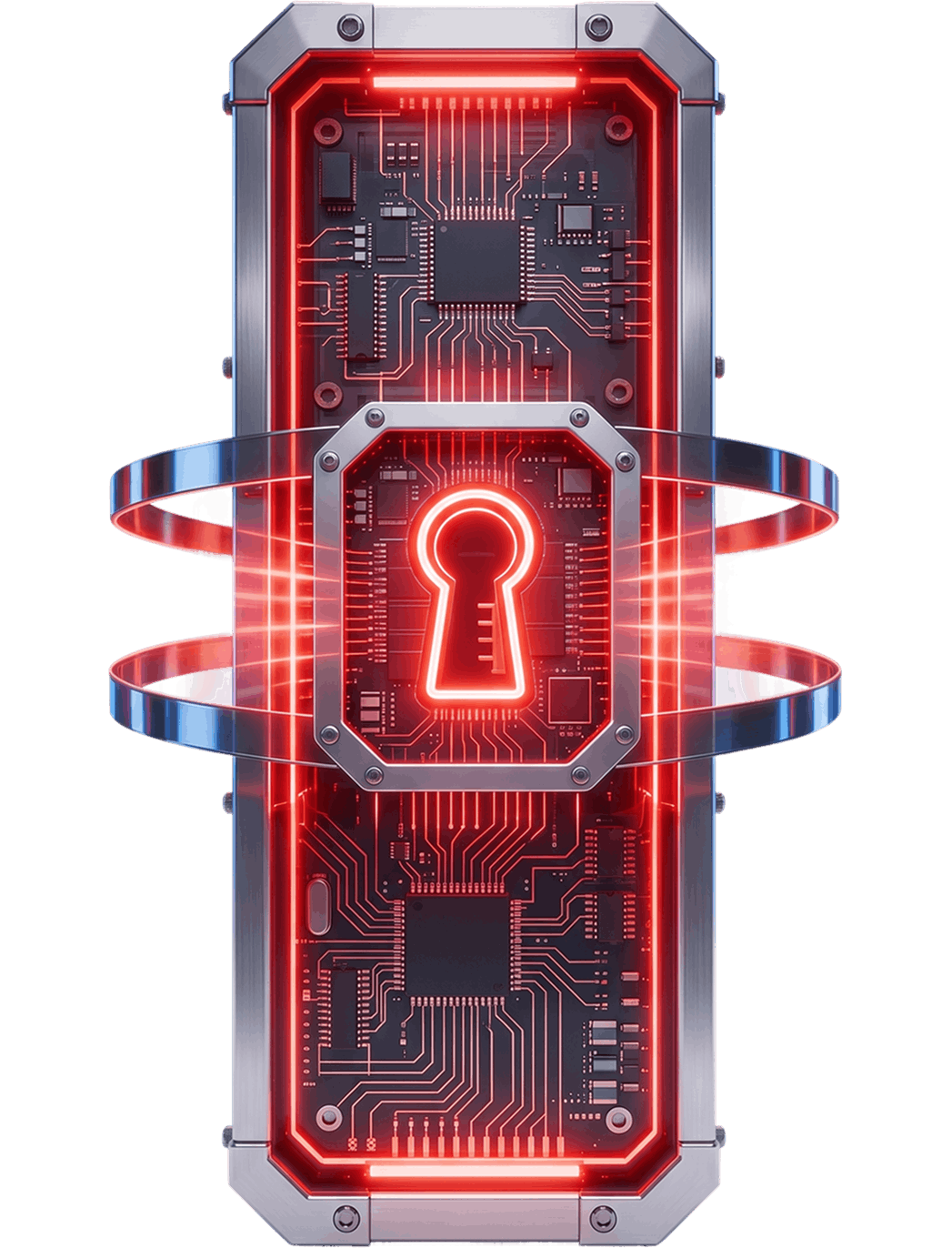
Futurex IoT CA is built on HSM technology, giving organizations protected key generation, protected key storage, tamper-resistant signing operations, and controlled access to sensitive certificate functions.

Hardware-backed certificate operations support:

  • Protected CA key generation and signing
  • Tamper-resistant storage for CA private keys
  • Role-based control over certificate operations
  • Stronger separation between trust anchors and operational workflows
  • Logged certificate events for operational review and governance

This is the core trust layer behind device certificate issuance. If the CA private key is weakly handled, the device identity model breaks with it.

rootOfTrust

IoT CA Capabilities 

Device Certificate Issuance

Device Certificate Issuance

Automate CSR processing, device enrollment, and X.509 certificate issuance for connected devices.

Manufacturing Provisioning Workflows

Manufacturing Provisioning Workflows

Support production-line certificate provisioning and certificate injection workflows tied to device build and staging processes.

CA Hierarchy and Trust Management

CA Hierarchy and Trust Management

Manage root, subordinate, and issuing CA relationships used to establish device trust chains and certificate validation paths.

Lifecycle and Status Control

Lifecycle and Status Control

Track expiration, renew deployed certificates, revoke compromised certificates, and validate certificate status through CRL and OCSP processes.

Policy and Audit Controls

Policy and Audit Controls

Apply certificate policy, document lifecycle events, and maintain records for certificate issuance, renewal, revocation, and replacement activity.

Deployment Flexibility

Deployment Flexibility

Support device certificate operations across edge, cloud, and hybrid environments where connected devices and validating systems operate across multiple locations.
IoT CA Architecture

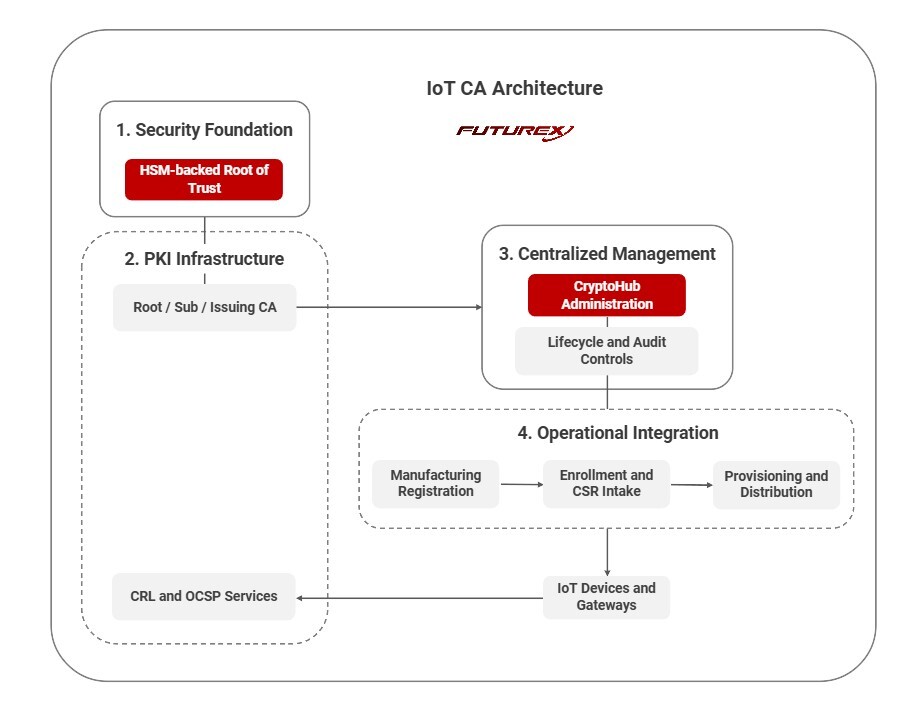
IoT CA fits into enterprise PKI and device identity infrastructure as the certificate authority layer for connected device issuance and lifecycle control.

A typical architecture includes:

  • CryptoHub ecosystem alignment for broader cryptographic administration
  • HSM-backed root of trust for CA key generation and signing
  • Root, subordinate, and issuing CA hierarchy
  • Device enrollment and CSR intake connected to manufacturing or registration workflows
  • Certificate provisioning and trust distribution to devices, gateways, and platforms
  • CRL and OCSP services for certificate status validation
  • Lifecycle controls for renewal, revocation, replacement, and audit logging

This architecture gives teams centralized control over device certificate operations without splitting trust management across disconnected tools.


IoT CA architecture diagram

Integrations

IoT CA integrates with the systems involved in device provisioning, device authentication, and certificate validation

Manufacturing and Provisioning Workflows

  • Production-line certificate provisioning
  • Device registration and certificate request handling
  • Certificate injection workflows during manufacturing

IoT and Enterprise Systems


  • IoT platforms
  • Connected device management environments
  • Enterprise applications and gateways that validate device identities

PKI and Trust Services


  • X.509 certificate workflows
  • Root, subordinate, and issuing CA hierarchies
  • TLS certificate usage for protected device communications
  • CRL and OCSP status validation

Deployment Environments


  • Edge deployments
  • Cloud-connected IoT environments
  • Hybrid operational models across factory and field infrastructure


Compliance Support

IoT CA supports governance and auditability for device certificate operations.

Futurex supports:

  • Certificate policy enforcement across issuance workflows
  • Logged lifecycle events for issuance, renewal, revocation, and replacement
  • Certificate status validation records through CRL and OCSP processes
  • Role-based control over sensitive CA operations
  • Traceable records tied to device identity and certificate history

For regulated device environments, that gives teams clearer documentation of what certificate actions occurred, when they occurred, and which systems or devices were affected.

Featured Resources

"10,000+ devices signed per batch, 5-9's availability, live-production, 3-month deployment supporting a multi-national, three continent scope. Solution supports hundreds of millions of manufactured IoT devices per year."


- Case Study "Enterprise CA, IoT for High Volume Manufacturing"

IoT Certificate Authority FAQ

What is IoT CA?

IoT CA is the certificate authority layer used to issue, manage, and validate device certificates for connected environments. It supports device identity from manufacturing through deployment and certificate retirement.

How does Futurex support manufacturing certificate provisioning?

Futurex supports production-line certificate workflows that can process device requests, apply certificate policy, provision X.509 certificates, and connect those certificates to trusted CA hierarchies before deployment. 

How does it protect CA private keys?

Futurex uses an HSM-backed model for key generation, private key storage, and certificate signing operations. That keeps sensitive CA functions inside tamper-resistant hardware boundaries.

How does it manage certificate renewal and revocation?

IoT CA supports expiration monitoring, certificate renewal, certificate replacement, revocation handling, and certificate status validation through CRL and OCSP processes.

How is this different from issuing CA or IoT key injection?

Issuing CA is a broader certificate authority function for enterprise certificate issuance. IoT CA applies that model to connected device identity, manufacturing provisioning, and fleet lifecycle control. IoT key injection focuses on key-loading workflows. IoT CA focuses on certificate issuance, trust chains, and certificate status.

Secure Device Identity from Factory to Field

Manual device certificate handling creates issuance delays, trust gaps, and weak audit trails. Futurex IoT CA gives organizations HSM-backed control for certificate issuance, lifecycle management, and trust validation across connected device environments.