Skip to content
Futurex Tops ABI Competitive Report as #1 Innovator!
  • There are no suggestions because the search field is empty.
Futurex Tops ABI Competitive Report as #1 Innovator!

Cloud Key Management

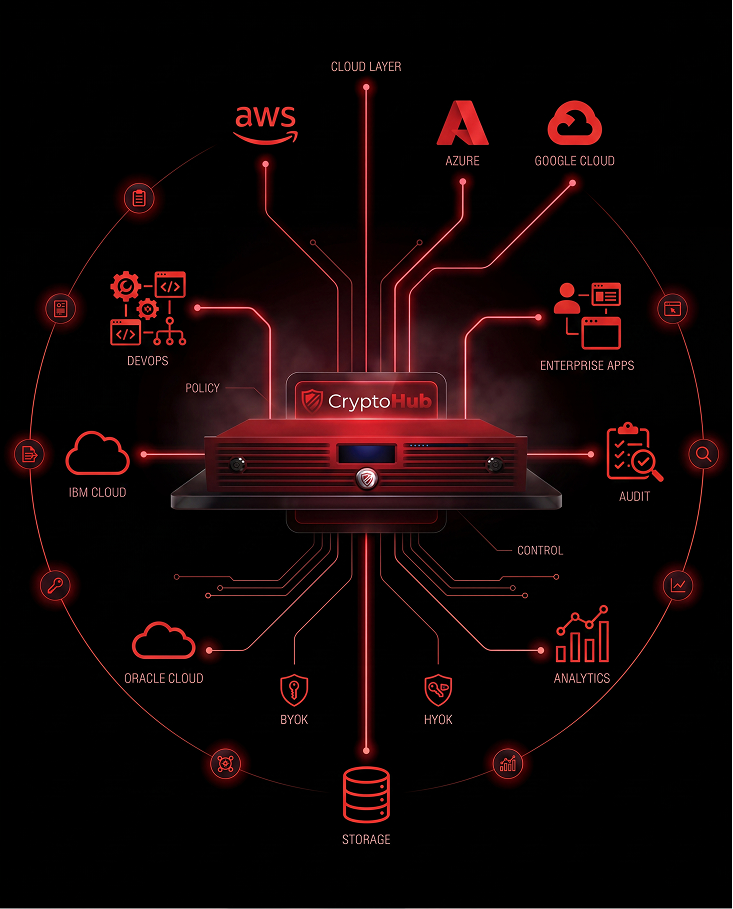
Centralize customer control of encryption keys across AWS, Microsoft Azure, Google Cloud, and hybrid infrastructure.

cloudKeyManagementHero-2
HSM-backed cloud key management

HSM-backed cloud key management

Centralized control across hybrid and multi-cloud environments

Centralized control across hybrid and multi-cloud environments

Standards-based integration with enterprise systems

Standards-based integration with enterprise systems

Audit-ready records for PCI-compliant operations

Audit-ready records for PCI-compliant operations

What Is Cloud Key Management?

Cloud key management gives security teams centralized control over the encryption keys used by cloud services, cloud applications, and hybrid infrastructure.

Teams can use it to:

  • maintain customer control of keys used in cloud platforms
  • connect cloud services to HSM-backed key infrastructure
  • coordinate governance and access policies across cloud environments
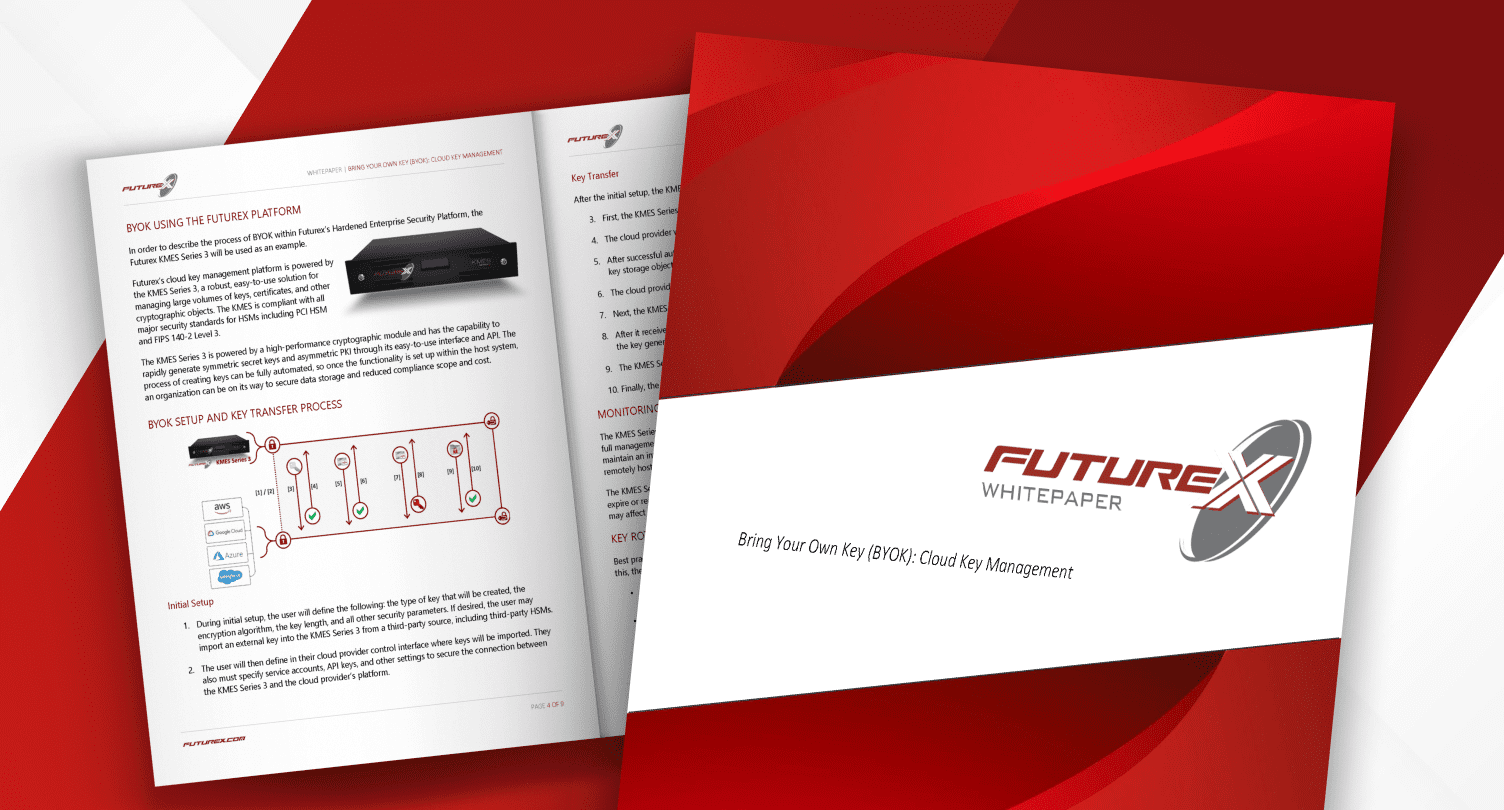
  • support Bring Your Own Key (BYOK) and external key management models
  • document key activity for audit and operational review


cloudKeyManagementWhatIs

Why Futurex for Cloud Key Management?


Cloud encryption often becomes fragmented across provider-native tools, separate access models, and disconnected audit records. That creates inconsistent control across AWS, Azure, Google Cloud, and hybrid infrastructure.

Futurex consolidates cloud key control into CryptoHub, a unified cryptographic platform built on HSM-backed architecture. It supports customer-controlled key management, provider integrations, role-based access controls, and audit documentation across major cloud environments. Futurex places CryptoHub and HSM-backed key custody at the center of cloud key operations, allowing cloud services to use customer-controlled keys without shifting policy and access control into separate provider-native workflows.

For organizations that need stronger separation between cloud workloads and key custody, Futurex supports BYOK and external key control models that keep key management anchored in trusted Futurex infrastructure rather than distributed across separate provider consoles. While others rely on disconnected provider-native controls to manage cloud key usage, Futurex delivers a centralized cloud key control plane with HSM-backed key custody, provider integration, and coordinated audit documentation across hybrid and multi-cloud environments.

Customer-controlled cloud key management also helps organizations address data residency requirements, regulatory obligations, and provider separation requirements that are difficult to satisfy with provider-managed encryption alone.

How Cloud Key Management Works

Futurex applies a centralized control model for cloud key management across major providers and hybrid environments. Security teams can connect cloud services, maintain customer control of keys, and apply consistent policy from a single platform.

Cloud Provider Integration

Cloud Provider Integration

Native integrations support AWS, Microsoft Azure, and Google Cloud key services.

Customer-Controlled Key Deployment

Customer-Controlled Key Deployment

BYOK and external key management models allow teams to generate and govern keys in HSM-backed Futurex infrastructure, then deploy them into supported cloud key services or retain them in trusted Futurex infrastructure for external key use.

Policy and Access Control

Policy and Access Control

Role-based permissions and governance controls help teams coordinate cloud key usage across providers and connected applications.

Rotation and Audit Visibility

Rotation and Audit Visibility

Teams can apply rotation schedules across cloud platforms and connected applications while documenting key operations for audit review.

Authentication and Credential Mapping-0f71-41d2-8cd3-d9ba30c62b8e 6

Authentication and Credential Mapping

Cloud integrations can be tied to delegated provider credentials and defined permissions for cloud key operations.

Challenges in Managing Cloud Keys at Enterprise Scale

Organizations frequently encounter challenges such as:

  • separate key controls are fragmented across cloud providers
  • inconsistent access governance between cloud services and enterprise systems
  • limited visibility into where cloud keys are used and how they're accessed
  • manual coordination for rotation across cloud workloads and applications
  • audit records are fragmented across provider consoles and security teams
  • policy drift as hybrid and multi-cloud environments expand

These challenges intensify as cloud services, storage platforms, analytics workloads, and DevOps pipelines spread across providers. At enterprise scale, fragmentation slows audit response, complicates policy alignment, and increases the risk of inconsistent key handling across cloud workloads. Futurex centralizes cloud key control, allowing teams to apply consistent policy, maintain customer control, and simplify coordination across provider-specific tools.

cloudKeyManagementChallenges-2

Crypto-Agility and Cloud Key Management

Cloud key management should support evolving cryptographic requirements without forcing teams to rebuild provider-specific workflows or migrate workloads.

Futurex provides centralized cloud key control across hybrid and multi-cloud environments, giving teams a stronger foundation for cryptographic transition planning and post-quantum migration.

As cryptographic requirements evolve, centralized cloud key management helps teams:

cloud visibility
Gain visibility into cloud cryptographic dependencies across providers.
cloud coordination
Coordinate policy without provider-specific reconfigurations
cryptographic transition
Support hybrid deployment models during cryptographic transitions
reduce cloud encryption disruption
Reduce disruption as cloud encryption standards change
safe and clock
Protect long-life cloud data against future decryption risk

Hardware Root of Trust for Cloud Key Management

Cloud encryption keys must be protected with the same level of security as the data they safeguard.

A hardware root of trust ensures that key generation and customer-controlled key governance begin in tamper-resistant hardware security modules. Futurex extends that control into cloud environments through BYOK workflows that import supported keys into cloud key services and external key management models that allow supported services to reference keys that remain in trusted Futurex infrastructure.

Hardware-backed cloud key management provides:

  • secure key generation inside HSM-backed infrastructure
  • protected key storage within validated hardware boundaries
  • customer-controlled key deployment into cloud platforms through BYOK import and external key reference models
  • strong access control enforcement through role-based permissions
  • documented key activity for audit and operational review

This architecture ensures that organizations maintain control over cloud encryption keys, even when workloads and data span multiple cloud providers.

rootOfTrust

Cloud Key Management Capabilities

Cloud key management platforms should provide comprehensive capabilities for managing keys across cloud providers, hybrid infrastructure, and enterprise systems.

Futurex Cloud Key Management includes:

multi cloud integration


Multi-Cloud Platform Integration

Native integrations with AWS Key Management Service, Azure Key Vault, Google Cloud EKM, Google Workspace Client-Side Encryption, and hybrid infrastructure for centralized key control.


byok


BYOK and External Key Management

Customer-controlled key models through secure key injection, external key management workflows, and delegated credential mapping for cloud services.

policy and access control


Advanced Policy and Access Control

Role-based permissions and governance controls help teams coordinate policy and key usage across cloud providers and connected applications.

clock


Automated Rotation and Lifecycle Management

Scheduled rotation policies and lifecycle controls are applied across cloud platforms, with rollback support for failed operations.

audit and compliance


Audit and Compliance Documentation

Comprehensive logging of key creation, access, rotation, and usage events for compliance review and operational analysis.

api integration


Standards-Based Integration

Native support for RESTful APIs, and cloud provider APIs for integration with enterprise systems and cloud-connected workflows.

cloud native support


Cloud-Native Workload Support

Protection for serverless functions, containerized applications, cloud storage, analytics workloads, and DevOps pipelines.

cloud visibility and monitoring


Operational Visibility and Monitoring

Support for monitoring and alerting across cloud key integrations and external key services, including service health and availability visibility in supported deployment models.

Cloud-Native Workload Support


Cloud-Native Workload Support

Protection for serverless functions, containerized applications, cloud storage, analytics workloads, and DevOps pipelines.

Operational Visibility and Monitoring


Operational Visibility and Monitoring

Support for monitoring and alerting across cloud key integrations and external key services, including service health and availability visibility in supported deployment models.

Cloud Key Management Architecture 

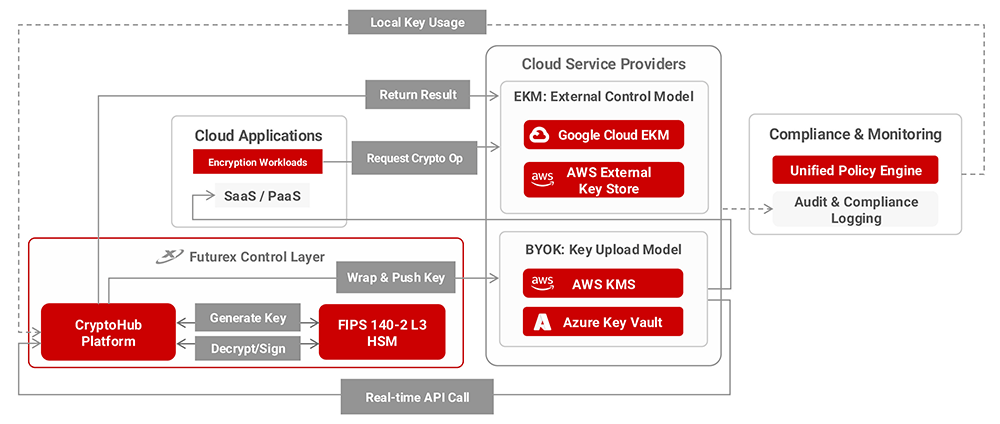
Cloud Key Management integrates into enterprise cryptographic infrastructure as a centralized control layer for cloud key usage across hybrid and multi-cloud environments.

A typical architecture includes:

  • CryptoHub as the cloud key orchestration platform
  • Hardware security modules providing root of trust for key generation and protection
  • native connections to AWS Key Management Service, Azure Key Vault, and Google Cloud EKM
  • BYOK and external key management workflows for customer-controlled keys
  • policy and access controls enforced across cloud providers
  • delegated credential mapping and trust relationships between Futurex infrastructure and cloud environments
  • rotation and lifecycle management functions with automated scheduling
  • audit and compliance logging for operational visibility and regulatory review
  • monitoring and alerting functions for integration health and service availability in supported deployment models
  • enterprise application and cloud workload integrations through REST APIs, and standards

This architecture enables teams to manage cloud keys consistently across providers without fragmenting control across separate provider-specific consoles.

Cloud-Key-Management-Workflow

Integrations Across Cloud and Enterprise Infrastructure

Encrypted data becomes harder to operate when keys, workloads, and enterprise systems follow different integration patterns. Cloud Key Management gives teams a common connection layer for cloud services, collaboration tools, enterprise applications, and hybrid infrastructure, using RESTful and provider-native interfaces to bridge modern workloads with legacy systems. 

aws


AWS Environments

  • AWS Key Management Service BYOK workflows for customer-controlled key injection
  • Native connectivity for AWS VPC and regional deployments
  • Support for AWS storage, compute, and application services
  • AWS External Key Store (XKS) workflows for customer-controlled key operations that keep key authorization and audit controls anchored outside AWS
azure


Microsoft Azure Environments

  • Azure Key Vault BYOK deployments with Premium tier support for HSM-backed keys
  • Credential mapping between Azure App Registrations
  • Delegated permissions for key import, creation, deletion, and usage operations
  • Policy coordination across Azure subscriptions, resource groups, and connected workloads
ms 365


Microsoft 365 and Collaboration Direction

  • Forward-looking compatibility direction for Microsoft Double Key Encryption (DKE) and customer-controlled encryption models in Microsoft 365 environments
google cloud


Google Cloud Environments

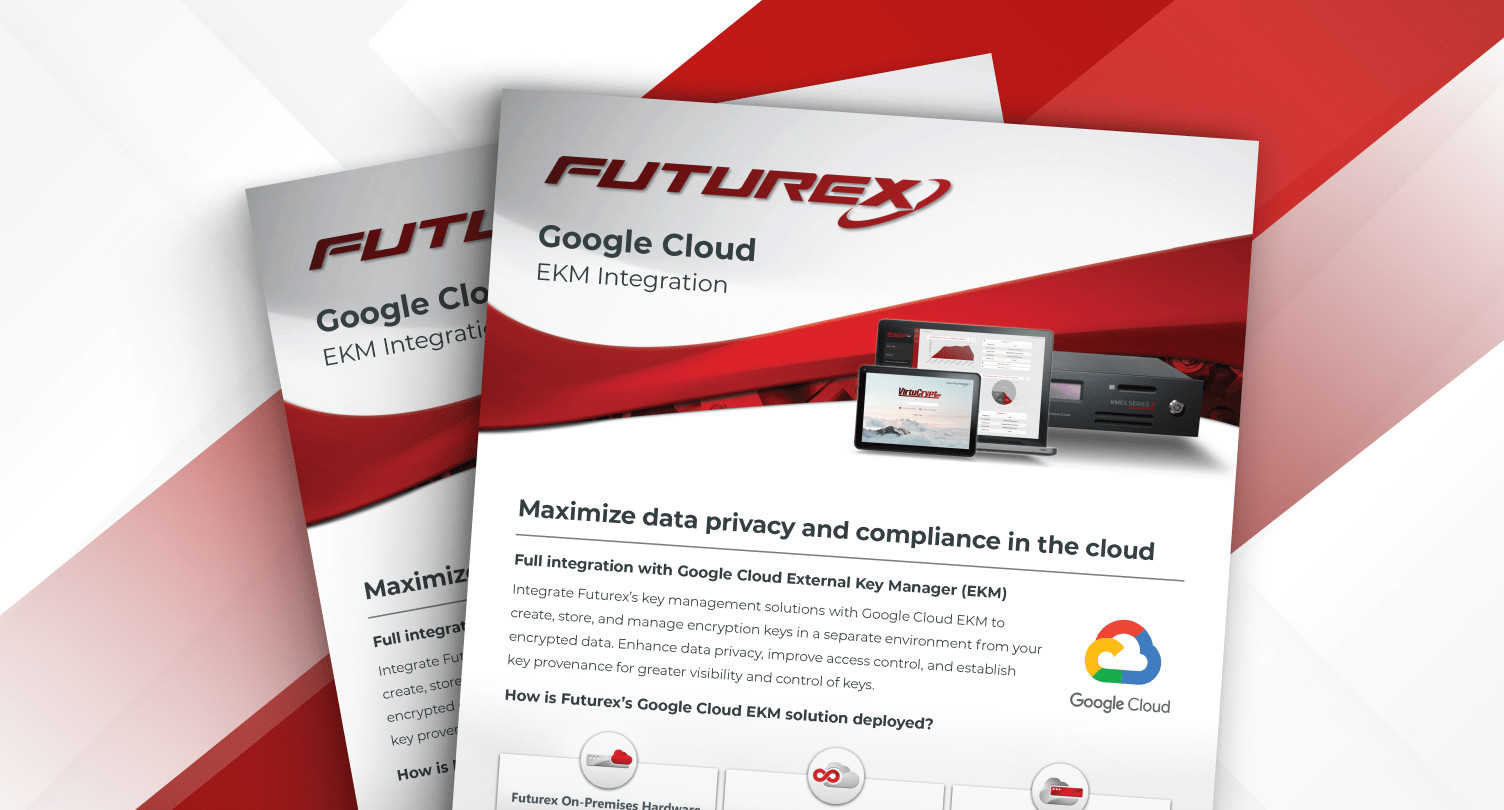
  • Google Cloud EKM workflows for externally managed keys
  • Support for BigQuery, Compute Engine, Cloud Storage, and other Google Cloud services protected with external key references
  • Project-level access control with grant and revoke capabilities
  • Key provenance models where keys remain in Futurex infrastructure and are never cached in Google Cloud
  • VPC-based and internet-based connectivity options for EKM deployments
google workspace


Google Workspace and Collaboration Environments

  • Google Workspace Client-Side Encryption support for Gmail, Drive, Docs, Sheets, Slides, and Meet
  • Browser-side encryption before data is transmitted to or stored by Google
  • External key service integration with CryptoHub and identity provider coordination for user authentication and access control
gear


Enterprise Application and Infrastructure Systems

  • Databases and application servers
  • Cloud storage, analytics platforms, and data lakes
  • Containerized workloads, serverless functions, and microservices
  • DevOps pipelines and CI/CD environments
  • Hybrid deployment models across on-premises and cloud infrastructure
Standards and Protocols


Standards and Protocols

  • RESTful APIs for cloud-native application integration
  • Cloud provider APIs (AWS SDK, Azure SDK, Google Cloud Client Libraries)
  • Enterprise integration frameworks for legacy and cloud-connected systems

CryptoHub Integration

Cloud key management is often fragmented across provider-native consoles, cloud key services, access policies, and audit records, creating inconsistent control across AWS, Microsoft Azure, Google Cloud, Google Workspace, and hybrid infrastructure.

Futurex CryptoHub centralizes cloud key control in a unified, HSM-backed platform, enabling organizations to connect cloud environments to customer-controlled key workflows. It supports BYOK workflows that import supported keys into cloud key services, external key management models that allow supported services to reference keys retained in trusted Futurex infrastructure, delegated provider permissions, RESTful APIs, cloud provider APIs, and coordinated governance across hybrid and multi-cloud environments.

While others depend on separate provider-native tools to manage cloud key usage, Futurex CryptoHub delivers centralized cloud key control with lower coordination overhead, stronger customer control, and clearer documentation for data residency, regulatory alignment, and cloud encryption operations.

Sunray_Orange (1)

Compliance Support

Cloud Key Management helps organizations maintain auditability, control, and traceability for encryption keys used in cloud environments.

Futurex supports:

  • documentation of key lifecycle events and access operations for audit review
  • role-based controls over cloud key creation, usage, and policy enforcement
  • rotation and access records tied to operational and compliance policies
  • documentation that helps teams trace which cloud service used a key, which policy applied, and when access permissions changed
  • regional deployment control and data residency compliance for cloud key storage
  • HSM-backed protection built on FIPS-validated hardware boundaries

For regulated cloud environments, this provides clearer documentation of key custody, access activity, and deployment boundaries across multiple cloud providers and hybrid infrastructure. Built for governance, audit readiness, and operational accountability across cloud key operations.
Cloud Key Management FAQ

What is cloud key management?

Cloud key management is the centralized administration of encryption keys used across cloud services, cloud applications, and hybrid infrastructure. It gives security teams control over key usage, access policy, and audit visibility across cloud environments.

How does Futurex support multi-cloud key management?

Futurex provides a centralized control layer for keys used across AWS, Microsoft Azure, Google Cloud, Google Workspace, and hybrid environments.

What is BYOK in cloud key management?

BYOK, or Bring Your Own Key, enables organizations to use customer-controlled encryption keys in cloud services rather than relying solely on provider-managed keys. With Futurex, teams can generate and govern keys in HSM-backed infrastructure before importing them into supported cloud key services. For external key management deployments such as Google Cloud EKM, cloud services reference keys that remain in trusted Futurex infrastructure.

How does Futurex support external key management in Google Cloud?

Futurex supports Google Cloud EKM deployment models that allow Google Cloud services to use externally managed keys while key custody remains in trusted Futurex infrastructure. This supports protected workloads such as BigQuery and Compute Engine persistent storage.

How does Futurex protect cloud keys?

Futurex secures key generation and protection in hardware security modules and extends control into cloud environments through centralized policy, access control, delegated provider permissions, and audit visibility.

How is this different from advanced key lifecycle management?

Cloud Key Management maintains customer-controlled keys across cloud services and hybrid infrastructure, including BYOK and external key management models that keep key custody secured in trusted Futurex infrastructure where supported. Advanced Key Lifecycle Management automates generation, distribution, rotation, revocation, archival, and destruction across all environments.

Featured Resources

"Customized remote key loading solution for worldwide ATM manufacturing organization implemented in less than two months to comply with encryption standards."


- Nautilus Hyosung Case Study

Strengthen Control of Your Cloud Encryption Keys

Cloud key fragmentation creates policy gaps, access risk, and operational complexity. Futurex Cloud Key Management provides centralized control, consistent policy enforcement, and unified audit visibility across hybrid and multi-cloud environments.