
Database TDE
Database Master Key Protection Outside the Database Engine
CryptoHub provides external database key management for SQL Server, MySQL, Oracle, MongoDB, MariaDB, PostgreSQL, and additional database platforms through EKM, KMIP, and PKCS#11, the interfaces that those databases already support, storing database master keys in FIPS 140-3 Level 3 validated HSMs and separating key administration from database administration.
Support for SQL Server, Oracle, MySQL, MongoDB, MariaDB, PostgreSQL, and more

Database master key never exists in plaintext outside the HSM boundary

Full audit log of every database key access event, by database and administrator

Separation of database administrator (DBA) and key admin roles: a documented PCI DSS and HIPAA compliance control

Consistent database key governance across all supported database platforms, in a single interface
The Decision You Are Actually Making
If you already have TDE deployed, the question is not whether to encrypt. The question is where the database master key lives, and whether the person who runs the database also controls the keys that protect it.
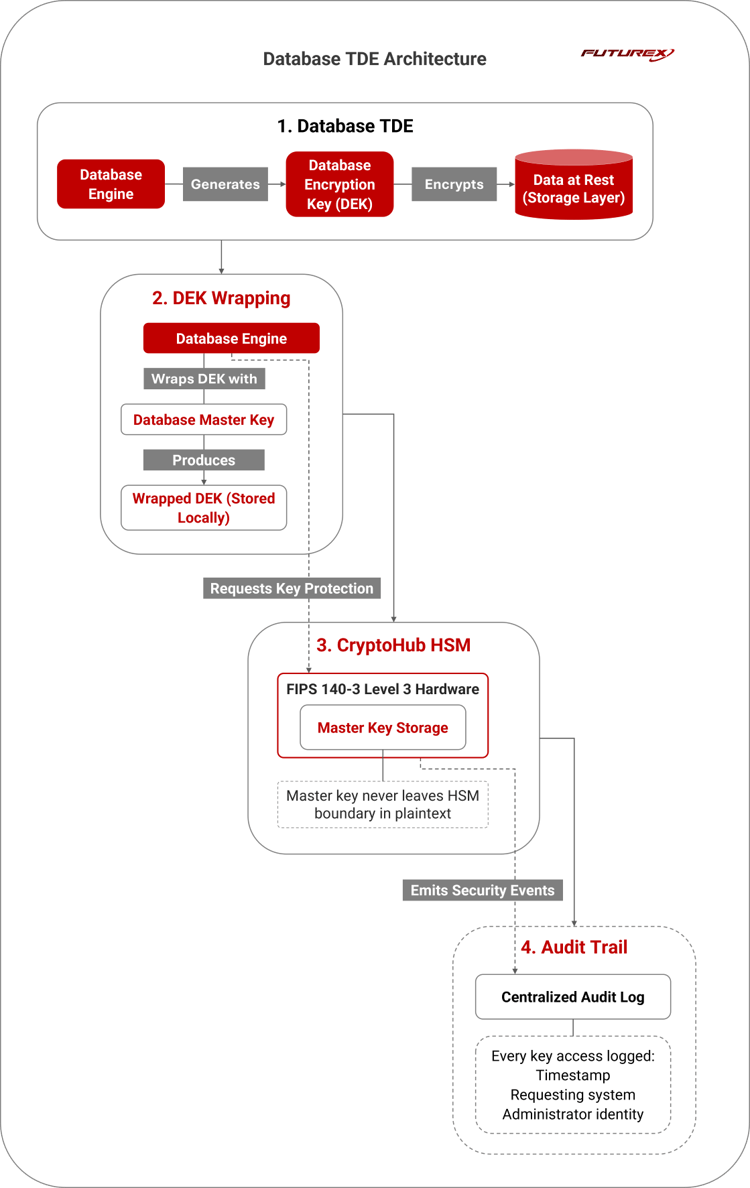
Database TDE encrypts data at rest at the storage layer without application changes. The database engine generates a data encryption key (DEK) and wraps it with a master key.
By default, that master key lives inside the database engine, on the same system as the data it protects.
External key management moves the database master key out: CryptoHub holds it inside HSM hardware, and the database requests it through a standard interface at startup or key rotation. Nothing changes at the application layer.
The result: the key that protects the database no longer lives with the data it protects, and the person who manages the database no longer controls the keys.
How Does CryptoHub Connect to Each Database?
CryptoHub uses the native key management interfaces built into each database platform, no additional agents, no proprietary connectors beyond what each database already supports.
SQL Server
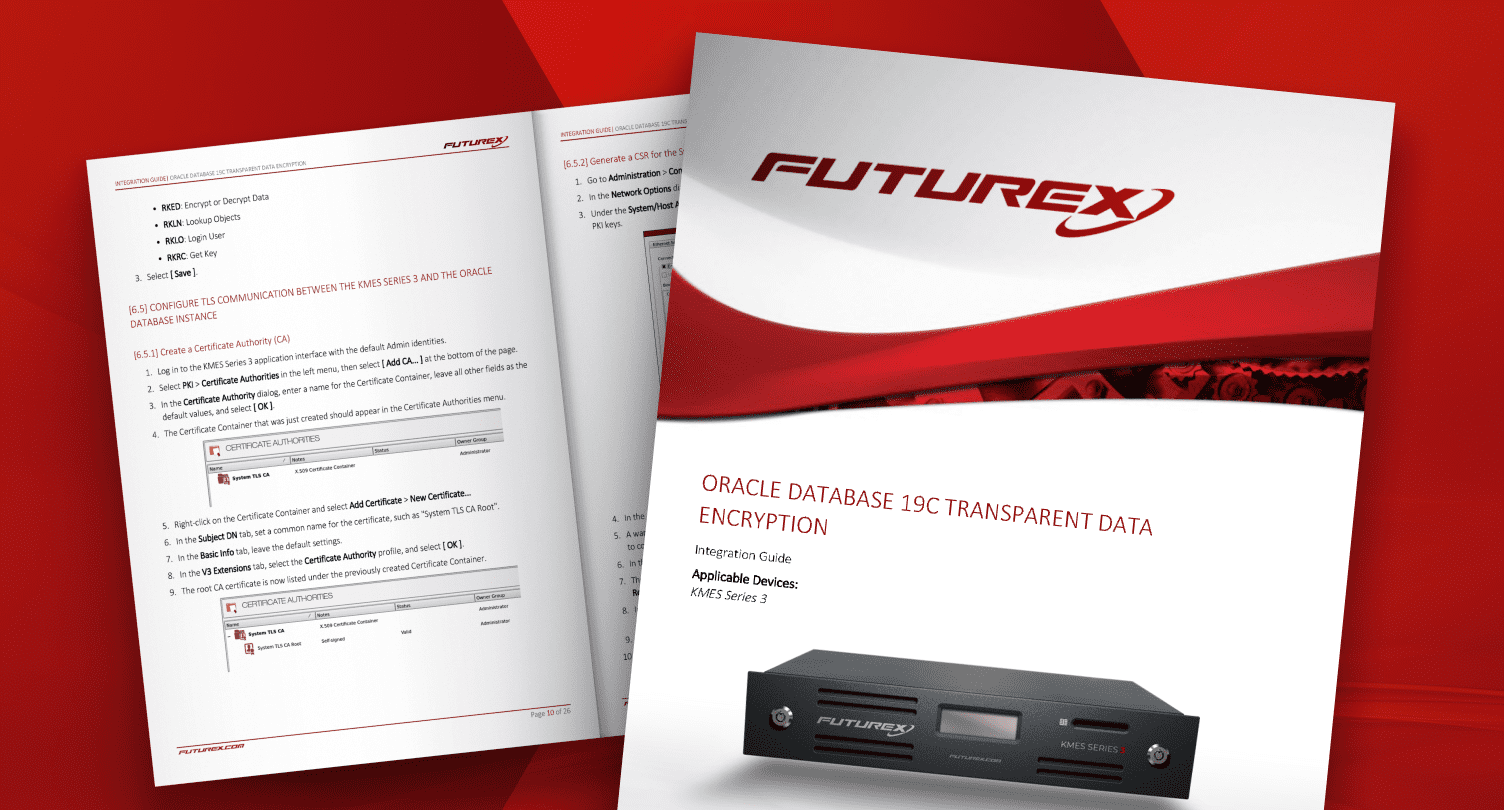
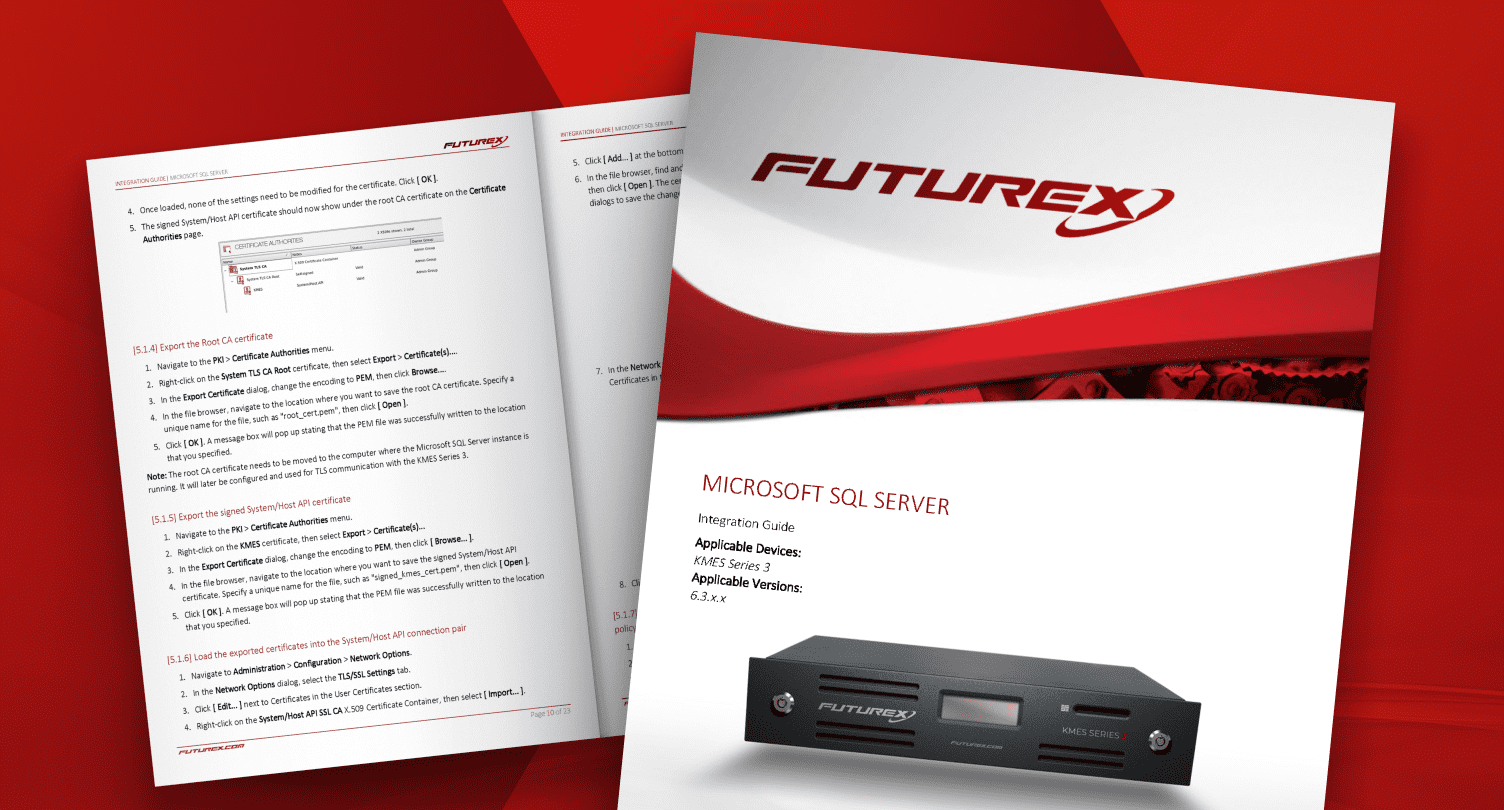
FXCL EKM (Extensible Key Management) provider. FXCL is the Futurex Cryptographic Library. The EKM provider installs as a SQL Server plugin and connects SQL Server's database TDE master key to CryptoHub. No changes to SQL Server configuration beyond the EKM provider installation.

MySQL Enterprise TDE
KMIP client via the keyring_okv plugin. MySQL Enterprise's TDE keyring architecture supports KMIP-based external HSM-backed key stores natively. CryptoHub acts as the KMIP server.

Oracle Database TDE
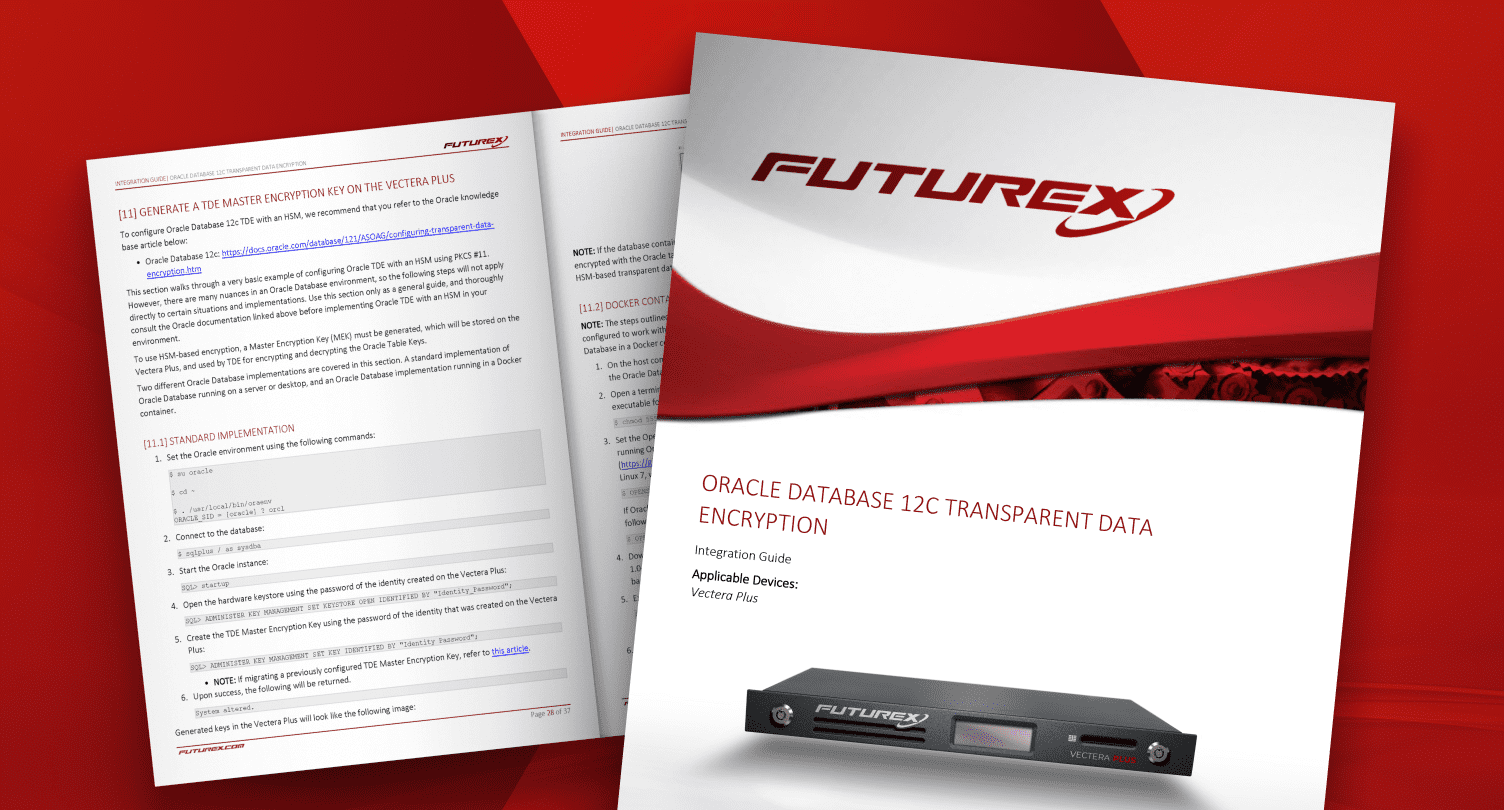
PKCS#11 interface. CryptoHub replaces the Oracle software wallet as the master key store through the standard PKCS#11 cryptographic interface. The Oracle DBA manages database operations; the key administrator manages CryptoHub.

MongoDB Encrypted Storage Engine
KMIP. MongoDB's encrypted storage engine supports KMIP for master key management. CryptoHub manages MongoDB master keys in the same platform as the rest of the organization's key inventory.

MariaDB and PostgreSQL
Transparent Data Protection (TDP) agent or column-level encryption. CryptoHub extends database key management to platforms without native EKM or KMIP support through TDP integration.

Additional database platforms can be supported through integration engineering - contact Futurex to discuss your environment.
CryptoHub Benefits for Multi-Database Key Management
Organizations running mixed database environments face a consistency problem with native database TDE key management: each platform stores database keys differently, rotates on a different schedule, and logs access in a separate location. Unified reporting across SQL Server, Oracle, and MySQL native key stores does not exist.
CryptoHub provides consistent database key governance across all supported databases. Database master keys for SQL Server, MySQL, Oracle, MongoDB, MariaDB, and PostgreSQL are managed under a single key lifecycle policy - consistent access controls, consistent rotation schedules, and a single audit log across all database platforms. The same platform also manages keys for application-layer encryption, tokenization, and file encryption, eliminating per-application key management silos for organizations that need to consolidate key governance broadly.
Deployment models
Database Transparent Data Encryption relies on secure, reliable access to master keys throughout the database lifecycle. CryptoHub provides centralized, HSM-backed database key management across on-premises, virtual, hybrid, and cloud deployments, enabling consistent key separation, lifecycle control, and policy enforcement while preserving native TDE operations.
On-Premises Appliance
Keep database master keys inside your own data center with dedicated HSM-backed protection. CryptoHub stores and manages TDE master keys on Futurex hardware, providing physical key separation, centralized governance, and low-latency access for databases running in regulated or air-gapped environments.

Virtual / Hybrid Appliance
Centralize TDE key management across virtualized and hybrid infrastructure. CryptoHub runs as a virtual appliance while maintaining a consistent interface for databases deployed across VMware, KVM, private cloud, and mixed on-premises environments, allowing master keys to remain centrally governed as workloads move.

CryptoHub Cloud (SaaS)
Move TDE master key management to a Futurex-managed HSM-backed service without changing database encryption workflows. Databases continue using Transparent Data Encryption while CryptoHub Cloud provides centralized key custody, lifecycle management, and hardware-backed protection, eliminating the need to operate on-premises key infrastructure.

Supported Databases and Interfaces
| Database | Interface | Protocol |
| SQL Server | FXCL EKM Provider | Microsoft Extensible Key Management |
| MySQL Enterprise TDE | keyring_okv plugin | KMIP |
| Oracle Database TDE | Oracle PKCS#11 interface | PKCS#11 |
| MongoDB Encrypted Storage | Native KMIP client | KMIP |
| MariaDB | TDP agent | Transparent Data Protection |
| PostgreSQL | TDP agent or column-level | Transparent Data Protection |
| Additional platforms | Integration engineering | Contact Futurex → |
Key Capabilities
Separation of database administration from key administration - documented, logged, and auditable

Key rotation, versioning, access control, and lifecycle management for database master keys

Comprehensive audit logging: key access events, rotation events, administrative actions

Backup and snapshot encryption key lifecycle management - including restore-path procedures
Consistent key governance across multiple database platforms in a single administrative interface

RBAC for key administrator roles with per-key and per-application access policy

Use Cases
SQL Server in a PCI DSS cardholder data environment
The FXCL EKM provider connects SQL Server TDE to CryptoHub, moving master key protection to FIPS 140-3 Level 3 hardware and establishing documented DBA/key admin role separation for PCI DSS 4.0 Requirement 3.7 compliance.

Oracle Database migration off local software wallet
Replace Oracle's software wallet with CryptoHub external HSM-backed key management through PKCS#11. Satisfies audit requirements for key-data separation; retains full Oracle DBA workflow with no application changes. Supports multi-cloud and hybrid environments where local wallet creates key custody complexity.

MySQL Enterprise TDE in a HIPAA-regulated environment
Connect MySQL Enterprise TDE to CryptoHub via KMIP and the keyring_okv plugin, establishing HSM-backed database master key protection and full key access audit logging for ePHI data stores.

MongoDB encrypted storage in multi-cloud or hybrid deployments
Manage MongoDB database master keys in CryptoHub rather than relying on environment-specific key stores, maintaining consistent key policy and audit continuity across cloud and on-premises MongoDB instances.

Mixed-database environments requiring unified key governance
SQL Server, Oracle, and MySQL running in the same environment? CryptoHub manages database master keys for all three under a single key lifecycle policy, with one audit log, one rotation schedule, and one administrative interface.
Database integrations (EKM, KMIP, PKCS#11) work identically across all deployment models.
Frequently Asked Questions
Does CryptoHub replace the database TDE implementation?
No. CryptoHub provides external key management for the database TDE master key. The database engine continues to handle TDE encryption and decryption. CryptoHub manages the master key that the database uses to protect its data encryption key.
Does external key management add latency to database queries?
No. Database key access requests to CryptoHub occur at database startup and during key rotation - not on individual queries. The database engine caches the key material it needs for normal operation. Query performance is not affected.
Which databases does CryptoHub support for external key management?
SQL Server (FXCL EKM), MySQL Enterprise TDE (KMIP/keyring_okv), Oracle Database TDE (PKCS#11), MongoDB (KMIP), MariaDB, and PostgreSQL (TDP or column-level encryption). Additional database platforms can be supported through integration engineering.
What is the FXCL EKM provider?
FXCL is the Futurex Cryptographic Library. The EKM provider is a SQL Server plugin that connects SQL Server's Extensible Key Management interface to CryptoHub, replacing SQL Server's local database key store with HSM-backed external key management.
How does CryptoHub support key rotation for database TDE?
Key rotation for database master keys is managed in CryptoHub. Rotation procedures are database-specific; Futurex documentation covers the process for each supported platform. All rotation events are logged with a full audit trail.
Can CryptoHub manage backup and snapshot encryption keys?
Yes. Database backups encrypted with TDE use the same database master key as the live database. CryptoHub manages the database master key's lifecycle, including access for backup and restore operations. Backup key management procedures should be documented as part of the initial integration design.
Does CryptoHub work in cloud, on-premises, and hybrid environments?
Yes. CryptoHub is available as an on-premises HSM appliance, as the VirtuCrypt cloud HSM service, or in hybrid configurations. The EKM, KMIP, and PKCS#11 integrations work identically across all deployment models.
Why does key co-location create an audit finding?
Storing the master key in the same system as the encrypted data is a recognized control gap. PCI DSS 4.0 Requirement 3.7.6 requires that key-encrypting keys be stored separately from data-encrypting keys and protected by FIPS 140-3 Level 3 validated hardware where possible. NIST SP 800-57 Part 1 specifies HSM-based protection for key-encrypting keys. HIPAA audit controls require documented access separation and key management auditability for ePHI environments.
The deeper issue is role separation. When a database administrator can access both the encrypted data and the keys that protect it, the encryption provides limited assurance. Auditors in PCI, HIPAA, and SOC 2 engagements treat this as a material finding. CryptoHub establishes a documented boundary: master keys held in FIPS 140-3 Level 3 HSM hardware, database and key administrators operating in separate systems with separate credentials, and every key access event logged with timestamp, requesting system, and administrator identity. The DBA does not have access to the keys, and the access record proves it.
What happens to database backups and snapshots?
Backup and snapshot management is the most commonly underplanned aspect of database TDE. Backups encrypted with TDE use the same master key as the live database - if that key is unavailable at restore time, the backup is unrestorable. This is the most common production failure mode for TDE deployments that lose key continuity.
CryptoHub manages master key availability, access control, and key lifecycle for both live database environments and backup scenarios through the same platform. Key rotation procedures account for backup compatibility; rotating the master key does not silently invalidate existing backup sets. Organizations should document restore-path key access procedures as part of the initial CryptoHub integration design, not after the first failed restore test.
Does external key management add latency?
No. Key access requests to CryptoHub occur at database startup and during key rotation events - not during individual read or write operations. The database engine caches the key material it needs for normal operation after the initial fetch. Per-query latency is not affected. Key rotation procedures vary by database platform; Futurex provides platform-specific rotation guides, and all rotation events are logged in CryptoHub.
Featured Resources
“Our electronic invoicing solution allowed us to expand our business and increase our service offerings, while continuing to provide our customers with the highest level of security for their sensitive data.”
- Jorge Cordova, IT/ Project Manager
Mis e-Folios
Move Master Keys Outside the Database
Build Your HSM, Your Way.
If your next audit requires documented database key-data separation, a DBA who cannot access the keys, and HSM-backed database master key protection, CryptoHub is how you get there. It connects to the database platforms you already run, through the interfaces those platforms already support, without changes to the application layer.
Talk to a database encryption architect about your environment. We will walk through the integration path for your specific database stack, the compliance controls CryptoHub establishes, and what the deployment looks like for your infrastructure. Start for Free.
Explore Related Solutions
Application Layer Encryption → | Tokenization → | File and Volume Encryption → | Enterprise Key Management →