Skip to content
Futurex Tops ABI Competitive Report as #1 Innovator!
  • There are no suggestions because the search field is empty.
Futurex Tops ABI Competitive Report as #1 Innovator!

ATM Key Injection

Securely provision and inject keys into ATM networks through HSM-backed control, validated key transport, and role-based operational workflows.

ATM Key Injection Futurex HSMs
FIPS 140-3 Level 3 / PCI HSM validation

FIPS 140-3 Level 3 / PCI HSM validation

TR-34 remote key loading and X9.143 key block support

TR-34 remote key loading and X9.143 key block support

Zero-downtime rotation and rollback support

Zero-downtime rotation and rollback support

Standards-based integration with enterprise systems

Standards-based integration with enterprise systems

What Is ATM Key Injection? 

ATM key injection is the controlled process of loading cryptographic keys into an ATM’s secure cryptographic device, typically the Encrypting PIN Pad (EPP), to enable PIN encryption, transaction processing, secure remote management, and device authentication. 

In practice, ATM key injection centers on establishing the Terminal Master Key (A-Key), which serves as the trust anchor for all downstream cryptographic operations within the device. 

ATM environments operate under a bank- or processor-controlled model, where financial institutions and authorized service providers govern the key hierarchy, distribution, and operational controls. This makes ATM key injection more tightly managed than POS environments, where key ownership and workflows are often distributed across multiple entities.

The Two Keys Involved

  • A-Key (Terminal Master Key)
    The foundational key is injected into the ATM EPP. It establishes device trust and enables secure communication with backend cryptographic systems.
  • B-Key (Session / Working Key)
    A working key exchanged or derived under the A-Key, used for PIN block encryption and transaction-level cryptographic operations during live ATM activity.

How the Key Hierarchy Works

ATM key injection follows a defined hierarchy:

  • HSM Root of Trust – Keys are generated and protected within a Hardware Security Module under strict controls
  • Master Key Layer – The A-Key is injected into the ATM to establish trust
  • Operational Key Layer – B-Keys and other working keys are used for transaction-level encryption, including PIN protection

End-to-End Key Injection Flow

A typical ATM key injection process includes secure key generation inside an HSM, controlled handling under dual control, secure transport or remote key loading, injection into the ATM’s Encrypting PIN Pad (EPP), validation of device readiness, and audit logging of each step. 

In traditional deployment models, establishing the Terminal Master Key (A-Key) usually requires coordinated key loading at both the ATM endpoint and the host HSM. This process is typically performed under dual control, with multiple operators involved at each stage to enforce split knowledge and reduce key exposure. While secure when following PCI practices for key handling, manual key ceremonies increase operational costs and overhead, introduce the potential for human error, and slow deployment timelines. 

In large ATM estates, this complexity scales quickly - requiring coordination of trust establishment, key distribution, activation status, and audit evidence across hundreds or thousands of terminals, often spanning branches, processors, and service organizations.

Why Futurex for ATM Key Injection?

ATM key injection directly supports bank-controlled transaction infrastructure, so the operating model demands tighter governance, stronger traceability, and more disciplined key handling than most endpoint environments. When key transport, loading, and validation are split across separate tools and manual workflows, teams face higher operational risk, slower ceremonies, and limited visibility into device state and key status.

Futurex centralizes ATM key injection in CryptoHub, a unified cryptographic platform built on HSM-backed architecture. For environments using manual A-Key ceremonies, CryptoHub replaces distributed key loading with a centralized model. An agent on the ATM establishes a certificate-based trusted connection to the HSM environment, allowing the Terminal Master Key (A-Key) to be securely injected from a central location, eliminating the need for coordinated, on-site key loading - reducing operational costs, human error, and accelerating deployment timelines.

CryptoHub supports these workflows with centralized governance for key generation and protection, certificate-based trust for remote loading, and secure transport using ANSI X9.143 (TR-31) key block formats alongside TR-34 remote key loading protocols. Role-based access controls with dual control enforcement and comprehensive audit logging ensure that every key event – from generation through injection and activation – is fully traceable across bank and processor environments.

For organizations already using ATM-driving host applications that abstract parts of the injection process, Futurex HSMs and CryptoHub integrate directly into those environments as the root of trust for PIN translation, session key generation and exchange, and broader ATM cryptographic operations.

By consolidating key injection, transport, validation, and audit into a single HSM-backed platform, Futurex replaces fragmented workflows with a controlled, centralized operating model built for secure, scalable ATM key management.

ATM Key Injection Workflow

ATM key injection follows a staged workflow designed to establish trust on the terminal first, then support downstream transaction cryptography.

Step 1: A-Key Generation and Control

The Terminal Master Key is generated inside a certified HSM. It is managed under dual control and split knowledge so that no single operator can access the full key. This key becomes the ATM’s cryptographic identity and trust anchor.

Step 2: Secure Transport or Remote Key Loading

The A-Key is transported using approved mechanisms or remote key-loading methods. In remote deployments, the ATM communicates through an approved software path to support secure loading into the EPP.

Step 3: Terminal Injection and A-Key Establishment

The A-Key is injected into the ATM’s EPP through a controlled workflow driven by the remote system or approved injection process. This is the critical trust-establishment event. Once the A-Key is present, the ATM can securely receive or derive operational keys.

Step 4: B-Key Establishment

After A-Key injection, B-Keys or session keys are derived or exchanged under the established trust model. These keys are used for PIN encryption and transaction-level cryptographic operations.

Step 5: Validation and Activation

The ATM validates the key load, confirms that the key is active and usable, and verifies readiness for transaction processing before entering service.

Step 6: Audit Logging and Compliance Documentation

Each stage, including generation, handling, transport, injection, validation, activation, and reload activity, is logged for traceability. This supports PCI PIN controls, internal bank governance, and regional audit requirements.

Step 1

A-Key Generation and Control

The Terminal Master Key is generated inside a certified HSM. It is managed under dual control and split knowledge so that no single operator can access the full key. This key becomes the ATM's cryptographic identity and trust anchor.

Step 2

Secure Transport or Remote Key Loading

The A-Key is transported using approved mechanisms or remote key-loading methods. In remote deployments, the ATM communicates through an approved software path to support secure loading into the EPP.

Step 3

Terminal Injection and A-Key Establishment

The A-Key is injected into the ATM's EPP through a controlled workflow driven by the remote system or approved injection process. This is the critical trust-establishment event. Once the A-Key is present, the ATM can securely receive or derive operational keys.

Step 4

B-Key Establishment

After A-Key injection, B-Keys or session keys are derived or exchanged under the established trust model. These keys are used for PIN encryption and transaction-level cryptographic operations.

Step 5

Validation and Activation

The ATM validates the key load, confirms that the key is active and usable, and verifies readiness for transaction processing before entering service.

Step 6

Audit Logging and Compliance Documentation

Each stage, including generation, handling, transport, injection, validation, activation and reload activity, is logged for traceability. This supports PCI pin controls, internal bank governance, and regional audit requirements.

ATM Key Security Hierarchy

ATM key injection depends on a tightly controlled security hierarchy designed to minimize exposure of master and terminal keys while preserving clear operational roles across the bank, processor, service organization, and device layers.

Root of Trust: HSM Layer

All keys originate and are protected within a Hardware Security Module (HSM). The HSM enforces cryptographic controls, generates keys within a tamper-resistant boundary, and ensures that master keys – such as the A-Key – are never exposed outside secure cryptographic operations.

Control Layer: Bank or Processor Domain

The issuing bank or payment processor defines the key management model, including when keys are generated, how they are approved, and how they are distributed. This layer governs policy enforcement, audit requirements, and lifecycle controls across the ATM estate.

Distribution & Operations Layer

Authorized service organizations and deployment teams execute key injection workflows under strict controls. Dual control, split knowledge, and role-based access ensure that no single entity can compromise key material during handling, transport, or loading.

Endpoint Layer: ATM and EPP

At the device level, the Encrypting PIN Pad (EPP) receives the Terminal Master Key (A-Key), establishing the root of trust for that ATM. From this anchor, the terminal can securely derive or exchange session keys (B-Keys) used for PIN encryption and transaction processing.

Remote Trust Establishment

For remote key loading, trust between the HSM and ATM is established using certificate-based mechanisms such as TR-34. This enables secure key injection over a network while maintaining end-to-end cryptographic integrity and ensuring that sensitive keys are never exposed in transit.


Endpoint Layer: ATM and EPP

At the device level, the Encrypting PIN Pad (EPP) receives the Terminal Master Key (A-Key), establishing the root of trust for that ATM. From this anchor, the terminal can securely derive or exchange session keys (B-Keys) used for PIN encryption and transaction processing.


Remote Trust Establishment

For remote key loading, trust between the HSM and ATM is established using certificate-based mechanisms such as TR-34. This enables secure key injection over a network while maintaining end-to-end cryptographic integrity and ensuring that sensitive keys are never exposed in transit.

ATM Key Injection Standards and Controls

ATM key injection environments rely on defined transport standards, PIN-handling controls, and operational load modes to maintain disciplined key establishment across distributed device fleets.

Standards Support

  • TR-34: remote key loading protocol with certificate-based trust establishment
  • ANSI X9.143 (TR-31): secure key block format for key transport and storage
  • PCI PIN: governance for PIN-related key handling and operational controls
  • ANSI X9.24: financial services key management standards
  • ISO 9564: PIN block and PIN encryption handling requirements
  • On-site Key Loading: local injection at ATM locations under controlled operational procedures with dual control enforcement
  • Remote Key Loading: centralized key distribution through validated remote workflows using certificate-based trust mechanisms
  • Staged Device Activation: keys loaded, validated, and activated as ATMs move into operational service

Operating Modes

  • On-site Key Loading: local injection at ATM locations under controlled operational procedures with dual control enforcement
  • Remote Key Loading: centralized key distribution through validated remote workflows using certificate-based trust mechanisms
  • Staged Device Activation: keys loaded, validated, and activated as ATMs move into operational service

Crypto-Agility and ATM Key Injection

ATM networks often remain in operation for extended periods, with individual terminals serving customers for years before hardware replacement cycles. This makes crypto-agility critical for adapting to evolving security requirements without wholesale infrastructure replacement.

Crypto-agile ATM key injection helps teams:

  • support cryptographic transitions across diverse ATM hardware platforms and manufacturers
  • implement remote rekeying operations without physical site visits or service disruptions
  • maintain backward compatibility during migration from legacy to modern encryption protocols
  • prepare ATM infrastructure for post-quantum cryptography and evolving PCI PIN requirements
  • adapt to changing regulatory requirements and security standards across regional banking operations

Futurex provides centralized control over ATM cryptographic operations through HSM-backed key generation and flexible injection protocols. This enables security teams to support algorithm transitions, implement enhanced PIN encryption standards, and prepare for post-quantum cryptography requirements across deployed ATM fleets.

Step 1: A-Key Generation and Control

The Terminal Master Key is generated inside a certified HSM. It is managed under dual control and split knowledge so that no single operator can access the full key. This key becomes the ATM’s cryptographic identity and trust anchor.

Step 2: Secure Transport or Remote Key Loading

The A-Key is transported using approved mechanisms or remote key-loading methods. In remote deployments, the ATM communicates through an approved software path to support secure loading into the EPP.

Step 3: Terminal Injection and A-Key Establishment

The A-Key is injected into the ATM’s EPP through a controlled workflow driven by the remote system or approved injection process. This is the critical trust-establishment event. Once the A-Key is present, the ATM can securely receive or derive operational keys.

Step 4: B-Key Establishment

After A-Key injection, B-Keys or session keys are derived or exchanged under the established trust model. These keys are used for PIN encryption and transaction-level cryptographic operations.

Step 5: Validation and Activation

The ATM validates the key load, confirms that the key is active and usable, and verifies readiness for transaction processing before entering service.

Step 6: Audit Logging and Compliance Documentation

Each stage, including generation, handling, transport, injection, validation, activation, and reload activity, is logged for traceability. This supports PCI PIN controls, internal bank governance, and regional audit requirements.

atmKeyInjectionCryptoAgility-1

ATM Key Injection Capabilities

ATM key injection platforms should provide comprehensive capabilities for secure key management across bank-controlled ATM infrastructure.

hsm with lock


HSM-Backed Key Generation and Protection

Secure generation and storage of ATM keys within FIPS-validated hardware security modules with controlled access and minimized exposure of sensitive cryptographic material.

cloud with lock


Remote and Onsite Key Loading

Support for remote key loading through TR-34 certificate-based protocols and onsite injection workflows using X9.143.

two gears


Dual Control and Split Knowledge

Apply operational safeguards ensuring no single person can control or reconstruct sensitive key material during generation, handling, approval, transport, or loading.

search document


Certificate-Based Trust Validation

Use certificate-based trust workflows to validate device identity and support remote ATM loading with PKI-backed cryptographic relationships.

stamp documents


Comprehensive Audit Documentation

Documentation of all key events including generation, transport, injection, validation, activation, and reload operations for compliance review and operational accountability.

team work


Multi-Party Operational Support

Support for bank-controlled ATM fleets, processor-managed infrastructures, and authorized service organization environments with role-based access controls and governance workflows.

ATM Key Injection Architecture

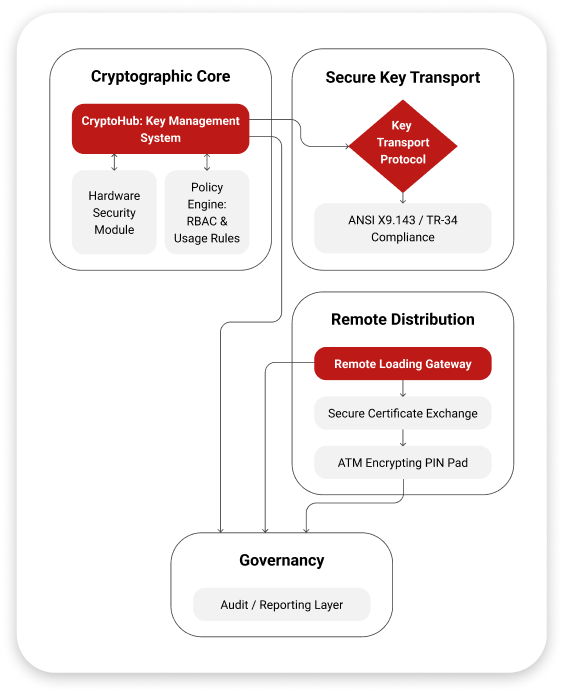
ATM Key Injection integrates into enterprise banking infrastructure as a centralized control layer for key generation, secure transport, terminal loading, and audit documentation across distributed ATM networks.

A typical Futurex architecture includes:

  • CryptoHub as the orchestration platform for ATM key injection control and policy enforcement
  • Hardware security modules providing root of trust for key generation and protected storage
  • Policy engine for approval routing, workflow control, and load authorization
  • Dual control and split knowledge enforcement for sensitive key operations
  • ANSI X9.143 key block handling for secure key transport and TR-34 remote key loading for certificate-based key delivery
  • Certificate-based trust mechanisms for remote ATM device validation
  • ATM management systems and remote loading gateways for secure communication paths
  • ATM endpoints with Encrypting PIN Pad (EPP) secure modules receiving injected keys
  • Monitoring and audit functions for key event documentation and terminal-to-key traceability
  • Compliance reporting for operational verification and regulatory review

This architecture enables banks, processors, and authorized service organizations to maintain centralized control over ATM key injection without fragmenting operations across disconnected systems and manual procedures.

atmKeyInjectionArchitecture-1

ATM Key Injection Integrations

ATM key injection must connect to the systems that govern terminal operations, transaction routing, device trust, and operational oversight.

These integrations enable organizations to manage ATM keys, device trust, and operational controls through a coordinated model across distributed banking environments.

ATM Terminal and Endpoint Systems

  • ATM terminal hardware platforms across multiple manufacturers
  • Encrypting PIN Pad (EPP) and secure cryptographic devices
  • endpoint loading interfaces and activation workflows

Transaction Processing and Banking Operations

  • ATM switch and transaction processor systems
  • bank host systems and core banking platforms
  • payment network coordination and authorization workflows
  • branch operations and service management systems

Device Management and Remote Administration

  • ATM device management platforms and fleet monitoring systems
  • remote administration interfaces for terminal control
  • deployment coordination and authorized service organization (ESO) systems

Certificate Authority and Trust Services

  • PKI infrastructure for certificate issuance and validation
  • certificate-based identity workflows supporting TR-34 remote key loading
  • trust chain management for device authentication and key transport validation


Certificate Authority and Trust Services

  • PKI infrastructure for certificate issuance and validation
  • certificate-based identity workflows supporting TR-34 remote key loading
  • trust chain management for device authentication and key transport validation

CryptoHub Integration

ATM key injection is often fragmented across bank hosts, processor environments, ATM management tools, field operations, and manual key ceremonies, creating inconsistent loading control, slower terminal activation, and limited visibility into device key status.

Futurex CryptoHub centralizes ATM key injection in a unified, HSM-backed control plane, enabling banks, processors, and authorized service operators to generate, protect, transport, load, validate, and audit ATM keys within secure cryptographic boundaries. It supports role-based workflows, dual control, split knowledge, certificate-based validation, key block handling, remote key loading, remote and onsite injection workflows, and audit-ready reporting across distributed ATM estates.

While others depend on disconnected tools and manual coordination to manage ATM key loading events, Futurex CryptoHub delivers centralized injection control with stronger operational governance, lower coordination burden, and unified audit visibility across key generation, transport, terminal loading, activation, and reload activity.


Sunray_Orange (1)

ATM Key Injection Compliance Support

ATM key injection programs require comprehensive documentation demonstrating that key generation, transport, injection, validation, and activation were performed under proper controls and mapped to specific devices, operators, and approval workflows.

Futurex supports compliance and governance efforts through:

  • alignment with PCI PIN security requirements and operational controls
  • support for X9.143 (TR-31) key block formats and TR-34 remote key loading workflows
  • documented separation of duties and dual control enforcement
  • complete audit trails for key generation, ceremony execution, transport, injection, activation, and reload operations
  • comprehensive reporting mapping keys to ATM terminals, operators, approval paths, and injection timestamps
  • FIPS 140-3 Level 3 and PCI PTS HSM validated hardware protection
  • support for internal bank governance policies and regional banking regulatory requirements

Organizations require comprehensive documentation demonstrating that key generation, transport, injection, validation, and activation were performed under proper controls and mapped to specific devices, operators, and approval workflows.

ATM Key Injection FAQ

What is ATM key injection?

ATM key injection is the controlled loading of cryptographic keys into ATM hardware, primarily the EPP, so the device can support PIN encryption, transaction processing, secure remote management, and trusted communication. In most ATM environments, the first priority is to securely establish the Terminal Master Key (A-Key).

How does remote ATM key loading work?

Remote ATM key loading uses approved transport and trust mechanisms to move key material from a centrally controlled HSM environment to the ATM endpoint. Certificate-based workflows, including TR-34 where applicable, help validate identity before the A-Key is loaded into the terminal’s secure cryptographic device.

What standards govern ATM key injection?

ATM key injection environments commonly rely on PCI PIN, ANSI X9.24, ANSI X9.143 (TR-31) for key block transport and storage, and TR-34 for remote key loading, and ISO 9564 for PIN block and PIN encryption handling, where relevant.

How does Futurex support bank-controlled ATM estates?

Futurex supports bank- and processor-controlled environments through CryptoHub, an HSM-backed control plane for key generation, secure transport, certificate-based workflows, role-based approvals, and audit-ready event logging across ATM injection operations.

How is ATM injection different from POS injection?

ATM injection typically operates inside a bank- or processor-controlled model where the institution governs the key hierarchy and distribution chain. POS environments are often more distributed across acquirers, merchants, service providers, and terminal estates, so the operational model and governance chain differ.

Featured Resources

"10,000+ devices signed per batch, 5-9's availability, live-production, 3-month deployment supporting a multi-national, three continent scope. Solution supports hundreds of millions of manufactured IoT devices per year."


- Case Study "Enterprise CA, IoT for High Volume Manufacturing"

Strengthen ATM Key Injection Operations

ATM key injection depends on disciplined key handling, trusted transport, controlled terminal loading, and clear audit evidence across distributed banking environments. Futurex provides the HSM-backed control, certificate-based trust mechanisms, and audit-ready documentation required to manage ATM key injection at enterprise scale.