POS Key Injection
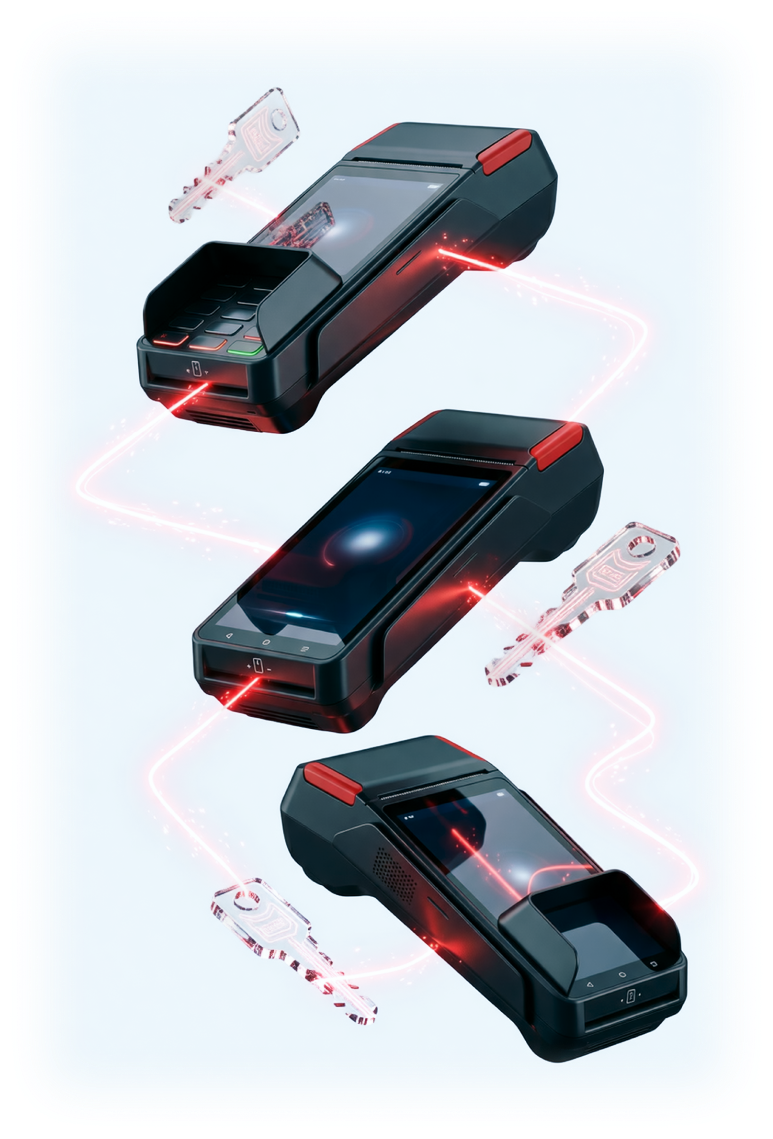
Securely load and manage cryptographic keys for payment terminals through HSM-backed workflows designed for manufacturers, distributors, acquirers, and bank-operated programs
PCI PIN & PCI HSM validated
X9.143 key block support
Support for TR-34 prepared for X9.139
Supports OEM, distributor, and acquirer workflows
Local and remote injection models
What Is POS Key Injection?
POS key injection is the process of securely loading cryptographic keys into payment terminals so they can encrypt transactions, support PIN functionality where applicable, and operate within payment networks.
In POS environments, key injection operates within a broader, multi-party payment ecosystem where keys must be securely exchanged and aligned across merchants, acquirers, processors, payment networks, and device injection facilities. This requires standardized key distribution and interoperability mechanisms to ensure that encrypted transaction data can be translated and processed across each participant in the transaction flow.
Operationally, the workflow centers on terminal production, staging, distribution, merchant rollout, and fleet activation. This differs from ATM-focused workflows, which are more tightly coupled to bank-owned infrastructure and follow different deployment and key management patterns.
POS Key Injection Operating Models
Futurex supports POS key injection through two primary operating models designed for different deployment scenarios.
Local / Workstation Staging
In this model, terminals are physically present at a Key Injection Facility (KIF), a manufacturer's clean room, or a certified distributor's staging site. Keys are loaded through workstation-based injection while devices are in hand during production, pre-deployment personalization, or staging operations.
This model is commonly used by:
- terminal manufacturers during production
- certified facilities performing pre-deployment staging
- distributors preparing terminals before merchant shipment
- merchant-side terminal activation after drop-shipment
- fleet-wide rekeying operations across deployed terminals
- replacement terminal activation in the field
- Manufacturer / OEM: almost exclusively Local / Workstation
- Distributor / ESO: transitioning from Local staging to Remote activation
- Acquirer / Bank: focused more heavily on Remote fleet management and rekeying
Remote / In-Field Loading
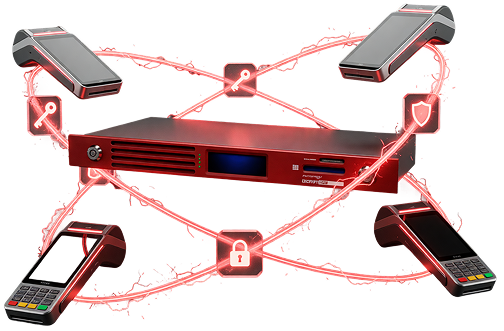
In remote workflows, terminals are already deployed at merchant locations. Devices connect through a Terminal Management System (TMS), and keys are loaded or updated remotely without requiring the terminal to return to a staging facility. CryptoHub Cloud supports remote activation and rekeying workflows, eliminating the need to deploy on-premises hardware at every distribution site.
This model is commonly used for:
Futurex supports two primary deployment models:
Comparison Overview
| Capability | Local Injection | Remote Injection |
|---|---|---|
| Requires physical access | Yes | No |
| Scales across large fleets | Limited | High |
| Infrastructure required | High | Low |
| Deployment speed | Slower | Faster |
Role alignment by model
- Manufacturer / OEM: almost exclusively Local / Workstation
- Distributor / ESO: transitioning from Local staging to Remote activation
- Acquirer / Bank: focused more heavily on Remote fleet management and rekeying
Regional Variations
In the United States, POS injection is most commonly performed by terminal manufacturers during build or staging, and by distributors or deployment partners before merchant installation.
In some regions outside the United States, banks may perform POS key injection directly as part of issuer-led or acquirer-led terminal programs.
Why Futurex for POS Key Injection?
POS programs depend on speed, repeatability, and traceability across large terminal fleets and multiple operating parties. Terminals must be personalized, staged, shipped, activated, tracked, and rekeyed without disrupting payment workflow requirements.
Futurex acts as the control layer for large-scale terminal personalization, staging, and secure rollout. For local workstation-based injection, Futurex supports controlled in-hand loading workflows used by OEMs, certified facilities, and distributor staging environments. For remote terminal activation and rekeying, CryptoHub Cloud is a good fit for TMS-driven deployment models because it eliminates the need to install on-premises hardware at every distributor site.
With Futurex, organizations can:
- support both local and remote injection models in a single platform
- eliminate the need for on-premises infrastructure at every staging location
- maintain consistent security controls across all deployment stages
- track terminal identity, key status, and partner activity in one system
In addition, as terminal volumes scale, Futurex eliminates traditional staging bottlenecks that increase costs and reduce deployment speed by enabling:
- remote terminal activation without staging infrastructure
- scalable key loading across distributed device fleets
- centralized control across manufacturers, distributors, and acquirers
- full audit traceability from injection through deployment
That gives manufacturers, distributors, acquirers, processors, and bank-led terminal programs a single operating model for secure terminal loading, shipment readiness, merchant activation, and fleet rekeying. It also improves partner coordination by tying key status, terminal identity, and deployment records to a single control framework.

POS Key Injection Workflow
Futurex organizes POS key injection around the terminal deployment lifecycle. Security and operations teams can apply policy, validate key loading, and document terminal identity events from manufacturing through fleet deployment.
These standards ensure cryptographic key protection and secure terminal deployment across manufacturer, distributor, and merchant workflows.
Challenges in POS Key Injection Environments
POS injection programs face operational complexity due to distributed device fleets, compressed deployment timelines, and shared responsibility across multiple organizations.
Common challenges include:
- high-volume terminal rollouts across multiple merchants, regions, and deployment partners
- coordination across manufacturers, distributors, processors, acquirers, and banks with different operational requirements
- the need to personalize thousands of terminals rapidly without losing traceability or cryptographic control
- regional variations in regulatory requirements and injection authorization
- audit and compliance pressure requiring complete terminal traceability from injection through deployment and ongoing operations
These challenges intensify when terminal loading, shipment readiness, merchant activation, and rekeying are managed across disconnected systems and manual processes. Futurex consolidates those workflows into a unified HSM-backed platform built for repeatable payment-device deployment at scale.
POS Key Injection Standards and Controls
POS key injection workflows depend on standards-based controls that govern how keys are generated, loaded, transported, and activated across payment terminal environments.
Futurex supports POS programs that operate with:
Key Generation and Protection
Secure generation of terminal keys within HSM-backed hardware with tamper-resistant protection before loading into payment devices.
POS Key Loading and Injection
Controlled loading of cryptographic keys into payment terminals through workstation-based injection or remote TMS-driven activation.
Validation and Quality Assurance
Validation of key loading results to ensure terminal readiness and cryptographic integrity before deployment or merchant activation.
Fleet Activation and Deployment
Staged terminal deployment to merchant locations with activation workflows tied to Terminal Management Systems or pre-loaded key configurations.
Ongoing Terminal Management
Fleet-wide rekeying operations, terminal replacement workflows, and remote key updates for deployed payment devices.
Crypto-Agility and POS Key Injection
POS Payment terminals often remain deployed for multiple years, requiring cryptographic flexibility as security requirements evolve. Crypto-agility in POS environments enables security teams to update terminal cryptography, support algorithm transitions, and manage fleet-wide rekeying without replacing physical devices.
Futurex provides centralized control over POS terminal cryptography through HSM-backed key generation and flexible deployment models. This enables teams to support legacy payment applications while planning for algorithm updates, post-quantum migration pathways, and evolving PCI security requirements across deployed terminal fleets.
Crypto-agile POS key injection helps teams:
- support cryptographic transitions across diverse terminal types and manufacturers
- implement fleet-wide rekeying operations without device returns or staging delays
- maintain backward compatibility during payment application migrations
- prepare for post-quantum cryptography requirements in payment infrastructure
- adapt to evolving PCI PIN, PTS, and P2PE security standards
Hardware Root of Trust for POS Key Injection
Payment terminal security depends on trust in how cryptographic keys are generated, protected, and loaded into devices throughout the deployment lifecycle.
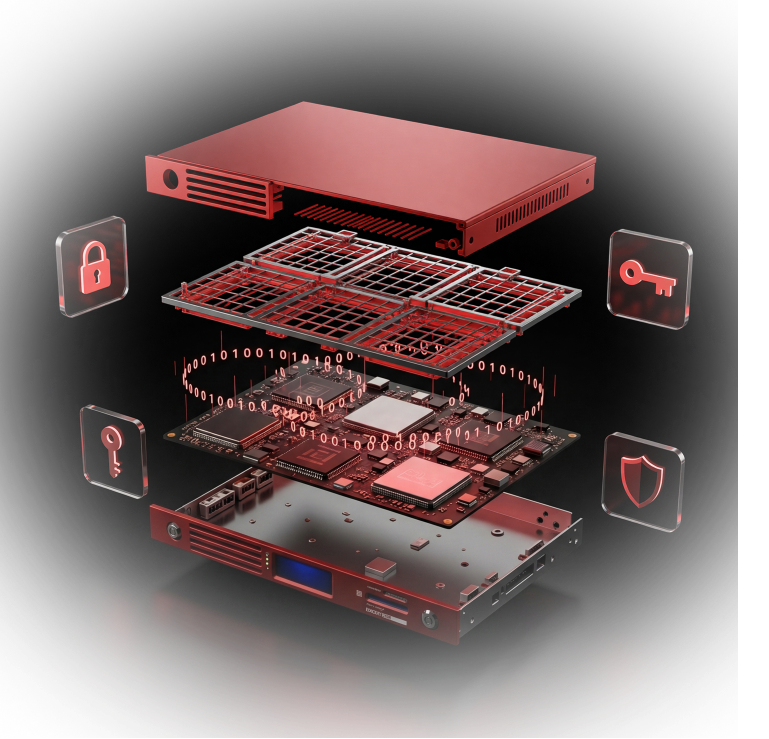
A hardware root of trust ensures POS key injection operations remain anchored within tamper-resistant hardware security modules validated to FIPS 140-3 Level 3 and PCI PTS HSM standards.
Hardware-backed POS key injection provides:
- secure key generation within FIPS-validated hardware boundaries
- protected key storage before loading into payment terminals
- tamper-resistant handling of key injection operations
- strong access control enforcement for sensitive terminal provisioning workflows
- comprehensive audit trails for terminal identity and key loading events
This architecture ensures cryptographic material remains protected within validated hardware during key generation, loading, and transport, providing a trusted foundation for payment terminal security from manufacturing through merchant deployment.
POS Key Injection Core Capabilities
POS key injection platforms must support both physical staging operations and remote fleet activation while maintaining control over keys, terminal identity, and partner permissions.
Futurex POS Key Injection includes:
Native Workstation Integration
Direct in-hand injection support for manufacturers, certified facilities, and distributor staging environments.
Remote TMS Gateway
API-driven remote terminal activation and fleet rekeying through Terminal Management Systems, enabling merchant-side deployment and field updates.
HSM-Backed Key Operations
Centralized key generation, wrapping, and protected storage within FIPS-validated hardware security modules.
Manufacturing and Distribution Workflow Support
Support for terminal identity assignment, pre-deployment personalization, and secure rollout across manufacturing and distribution partners.
Secure Key Block Transport
Controlled terminal loading using secure key block transport methods aligned to payment-environment requirements.
Role-Based Access Controls
Partner-specific permissions for manufacturers, distributors, acquirers, banks, and operational staff.
Comprehensive Fleet Audit Logging and Reporting
Centralized documentation of terminal identity, key events, partner actions, and deployment records for compliance review.
Fleet Management and Rekeying Support
Support for terminal replacement, staged deployment sequencing, and remote fleet-wide rekeying operations without device returns.
Comprehensive Fleet Audit Logging and Reporting
Centralized documentation of terminal identity, key events, partner actions, and deployment records for compliance review.
Fleet Management and Rekeying Support
Support for terminal replacement, staged deployment sequencing, and remote fleet-wide rekeying operations without device returns.
Comprehensive Fleet Audit Logging and Reporting
Centralized documentation of terminal identity, key events, partner actions, and deployment records for compliance review.
Fleet Management and Rekeying Support
Support for terminal replacement, staged deployment sequencing, and remote fleet-wide rekeying operations without device returns.
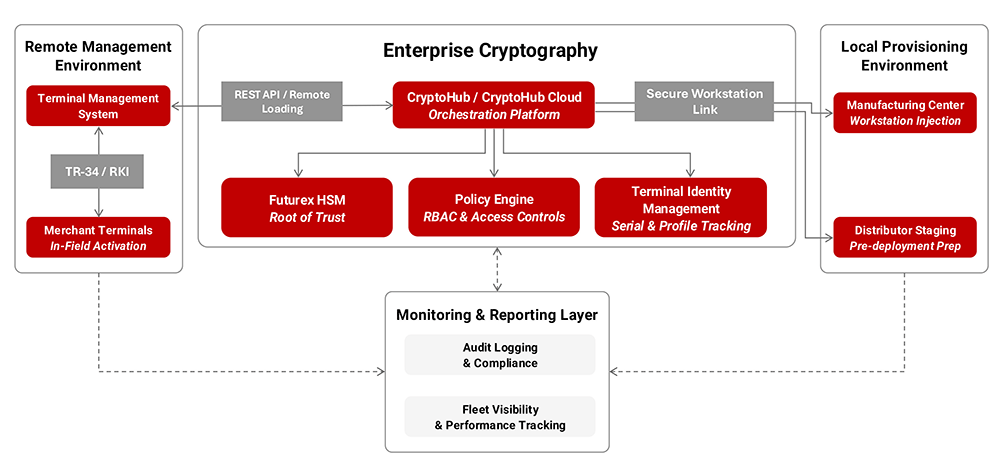
POS Key Injection Architecture
POS Key Injection integrates into enterprise payment infrastructure as a centralized control layer for terminal provisioning across manufacturing, staging, deployment, and fleet management.
A typical architecture includes:
- CryptoHub or CryptoHub Cloud as the orchestration platform for provisioning control
- hardware security modules providing root of trust for key generation and protected storage
- workstation integration for Key Injection Facilities and manufacturing environments
- Terminal Management System (TMS) integration for remote activation and fleet rekeying
- policy enforcement and access controls by partner type and deployment stage
- terminal identity management and key status tracking across the deployment chain
- monitoring and audit functions for provisioning operations and fleet visibility
- connections to manufacturer systems, distributor staging environments, and merchant deployment workflows
This architecture enables teams to maintain centralized control over terminal key loading and fleet rekeying operations while keeping device identity, key status, and deployment records visible across manufacturing, distribution, and merchant environments.
Integrations Across Payment Terminal Ecosystems
POS key injection depends on integration across the systems that stage, load, deploy, activate, and monitor payment terminals.
Futurex supports integrations with:
Terminal Manufacturers and OEMs
- payment terminal manufacturers and production systems
- Key Injection Facility (KIF) workstation environments
- manufacturing execution systems for terminal personalization
Distributor and Staging Operations
- distributor staging systems and warehouse management
- deployment partner provisioning workflows
- merchant onboarding and terminal assignment systems
Terminal Management Systems
- Terminal Management System (TMS) platforms for remote activation
- cloud-based terminal fleet management solutions
- remote rekeying and terminal update workflows
Payment Processing Infrastructure
- acquirer and processor onboarding systems
- payment application and device management platforms
- PCI P2PE environments and merchant deployment tools
Banking and Regional Programs
- issuer-led terminal deployment programs
- acquirer-managed merchant terminal fleets
- bank-operated key injection workflows in applicable regions
Standards and Protocols
- X9.143 (formerly TR-31) key block format for key exchange
- TR-34 asymmetric key distribution protocol
- PCI PTS and PCI PIN compliance workflows
These integrations enable organizations to maintain consistent terminal provisioning operations across manufacturing, distribution, merchant deployment, and remote fleet management.
CryptoHub Integration
POS key injection is often fragmented across manufacturer production systems, Key Injection Facilities, distributor staging sites, Terminal Management Systems, and bank or acquirer-led deployment programs. This creates manual coordination, inconsistent terminal traceability, and limited visibility into key status, operator activity, and provisioning records across the POS rollout lifecycle.
Futurex CryptoHub centralizes POS key injection in a unified, HSM-backed platform, enabling organizations to manage workstation-based loading, remote TMS-driven activation, replacement terminal provisioning, and fleet-wide rekeying within secure cryptographic boundaries. It supports local and remote injection models, role-based access control, partner-specific permissions, terminal identity tracking, audit logging, X9.143 key block workflows, TR-34 asymmetric key distribution, and preparation for X9.139 across distributed payment terminal environments.
While others depend on disconnected staging tools, manual partner handoffs, and separate systems for remote activation, Futurex CryptoHub delivers centralized POS key injection control with HSM-backed protection, lower infrastructure complexity, and unified audit visibility from terminal loading through merchant activation and fleet rekeying.
.png?width=750&height=580&name=Sunray_Orange%20(1).png)
Compliance Support
POS key injection programs require comprehensive documentation of how terminals were loaded, which parties performed provisioning operations, and where injection events occurred throughout the deployment chain.
Futurex supports:
- alignment with PCI PTS (Payment Terminal Security) requirements and PCI PIN security requirements
- X9.143 (formerly TR-31) key block format compliance
- full support for TR-34 and prepared for X9.139
- secure key block handling and transport protocols
- comprehensive audit trails for manufacturer injection, distributor staging, terminal shipment, merchant activation, and fleet rekeying events
- complete documentation of operator identity, Key Injection Facility location, terminal serial numbers, and key loading timestamps
- FIPS 140-3 Level 3 and PCI PTS HSM validated hardware protection
For payment teams, that means stronger traceability from staging through deployment, with records that support audit review and operational accountability across the terminal fleet.
POS Key Injection FAQ
What is the difference between Local and Remote key injection?
Local key injection occurs when the terminal is physically present in a clean room, a Key Injection Facility, or a staging site, and keys are loaded via a workstation-based process. Remote key injection happens when the terminal is already in the field and receives keys or rekey commands through a Terminal Management System.
Does Futurex support workstation-based injection for Key Injection Facilities?
Yes. Futurex supports workstation-based injection for in-hand terminal loading in manufacturer and distributor environments where devices are staged, personalized, or prepared before shipment.
Can I use CryptoHub Cloud for both local staging and remote in-field rekeying?
CryptoHub Cloud is optimized for remote and TMS-driven activation models, providing cloud-based key management for merchant-side terminal deployment and fleet-wide rekeying operations. Local staging workflows at Key Injection Facilities are supported through Futurex workstation-based injection environments with HSM-backed key operations.
Who performs POS injection in the U.S.?
In the U.S., POS injection is commonly handled by terminal manufacturers during production or staging, and by distributors or deployment partners before merchant installation.
What standards govern POS key loading?
POS key loading workflows may involve PCI PTS, PCI PIN, P2PE, X9.143, TR-34, relevant key block requirements, and EMV-related payment flow or device certification dependencies.
How does Futurex support OEM and distributor workflows?
Futurex supports both workstation-based loading and remote activation models, enabling OEMs and distributors to control workflows for staging, shipment readiness, merchant activation, rekeying, and audit logging across large device fleets.
Featured Resources
"10,000+ devices signed per batch, 5-9's availability, live-production, 3-month deployment supporting a multi-national, three continent scope. Solution supports hundreds of millions of manufactured IoT devices per year."
- Case Study "Enterprise CA, IoT for High Volume Manufacturing"
Strengthen Your POS Key Injection Operations
POS terminal rollout depends on controlled key loading, partner coordination, and clear device traceability from staging through activation. Futurex provides the HSM-backed workflows, centralized control, and audit visibility required to manage POS key injection at an enterprise scale.