
Offline Root CA
Protect the trust anchor of your private PKI with offline Root CA operations, HSM‑protected root keys, subordinate CA signing controls, and policy‑enforced certificate lifecycle governance.
Offline isolation for root CA operations

HSM-protected root private key storage

Subordinate CA signing and trust chain control

Audit trails, access controls, and revocation support
What Is Offline Root CA?
Offline Root CA is the highest-trust certificate authority in a private PKI hierarchy. It protects the root private key in an offline operating model and signs the subordinate CA certificates that anchor trust across the rest of the environment.
Teams can use it to:
- Generate the root private key inside HSM-backed, tamper-resistant hardware
- Issue and sign root and subordinate CA certificates
- Validate certificate signing requests against organizational certificate policy
- Distribute trusted root certificates to operating systems, browsers, and trust stores
- Maintain audit records, revocation controls, and access governance for root CA operations
Why Futurex for Offline Root CA?
Root CA governance often spans offline procedures, HSM administration, subordinate CA workflows, trust store updates, and audit records. That creates manual coordination at the highest-trust layer of PKI.
Futurex Offline Root CA integrates root key generation, root certificate signing, subordinate CA certificate issuance, and certificate policy enforcement into a single HSM‑backed operating model designed for network isolation. Teams can keep the root private key offline, sign intermediate and issuing CA certificates, validate certificate signing requests, and document root trust operations for compliance review.
Where disconnected tools spread root signing, certificate policy enforcement, revocation oversight, and trust chain records across separate systems, Futurex provides a controlled Root CA model with hardware‑backed key protection and clearer operational governance.
Offline Root CA Operations
Futurex concentrates the highest-assurance PKI tasks inside an offline, HSM-backed Root CA model. Security teams can establish root trust, authorize subordinate CAs, and maintain documented control over certificate hierarchy operations.
Root Key Generation
Generate the root private key inside tamper-resistant hardware using hardware-based entropy and controlled access procedures.
Root Certificate Issuance
Create and sign the root certificate offline to establish the top of the certificate hierarchy and the basis for enterprise-wide trust.
Subordinate CA Signing
Issue and sign intermediate CA and issuing CA certificates with certificate policy enforcement and certificate signing request validation.
Trust Establishment and Distribution
Enable secure distribution of trusted root certificates, ensuring certificate chain integrity and consistent trust-store alignment across environments.
Audit, Revocation, and Oversight
Track root CA operations through audit logs, revocation status records, CRL distribution point management, and certificate validation workflows.
Challenges in Managing Offline Root CAs at Enterprise Scale
Organizations often face challenges such as:
- keeping the root private key offline while still supporting subordinate CA issuance
- coordinating certificate policy enforcement across multiple business units and CA hierarchies
- maintaining consistent trust distribution across browsers, operating systems, servers, and directories
- documenting root signing, revocation, and access events for audit review
- reducing operational risk when root CA work depends on manual coordination and separate tools
- planning algorithm transitions without weakening the trust anchor
These challenges grow when root CA governance spans offline procedures, HSM controls, certificate authority workflows, server environments, and relying systems. Futurex brings root key protection, subordinate CA authorization, certificate policy validation, and audit evidence into a single controlled operating model.
For organizations modernizing private PKI, this also creates a stronger foundation for future cryptographic migration planning and crypto‑agility initiatives.
Crypto-Agility and Offline Root CA
Offline Root CAs protect long-life trust anchors. That makes algorithm agility a governance issue, not only a cryptographic one.
Futurex supports RSA, ECC, and emerging quantum-resistant algorithms, along with hybrid certificate models for staged transition planning. Security teams can introduce new cryptographic standards at the root and subordinate CA levels without rebuilding the certificate hierarchy from scratch.
Crypto-agile Offline Root CA operations matter when organizations need to:
Introduce new algorithms at the trust-anchor layer

Stage hybrid certificate transitions
Update root and subordinate CA policies as standards evolve
Plan PQC migration for long-life certificates and sensitive data
Hardware Root of Trust for Offline Root CA Operations
The value of an Offline Root CA depends on how the root private key is generated, stored, and used. Futurex protects those operations inside proprietary HSM infrastructure with FIPS 140-3 Level 3 validation and tamper-resistant controls.
Hardware-backed root CA operations provide:
- HSM-protected root private key storage
- hardware-based entropy for root key generation
- protected signing operations inside validated hardware boundaries
- role-based permissions for sensitive certificate authority actions
- multi-factor authentication for high-assurance access control
- logged root CA events for audit and compliance review
This architecture keeps the root of trust inside controlled hardware boundaries even when other infrastructure layers change.
Offline Root CA Capabilities
Offline Root CA platforms must store and use the root private key in tamper-resistant, validated hardware before certificate hierarchy operations occur.
Network-Isolated Root Operations
Offline operation for root CA tasks to reduce exposure to network-connected threats at the trust-anchor layer.
Subordinate CA Management
Controlled issuance and signing of intermediate CA and issuing CA certificates across enterprise PKI hierarchies.
Certificate Policy Enforcement
Validation of certificate signing requests and policy requirements before root or subordinate CA actions occur.
Audit Trails and Access Control
Documented root CA activity, role-based permissions, and multi-factor authentication for sensitive operations.
Migration and Algorithm Agility
Support for algorithm transition planning, hybrid certificate models, and future cryptographic updates at the root trust layer.
Standards-Based Certificate Operations
Support for X.509 certificates, certificate signing request processing, certificate chain validation, CRL distribution points, and OCSP-based status workflows.
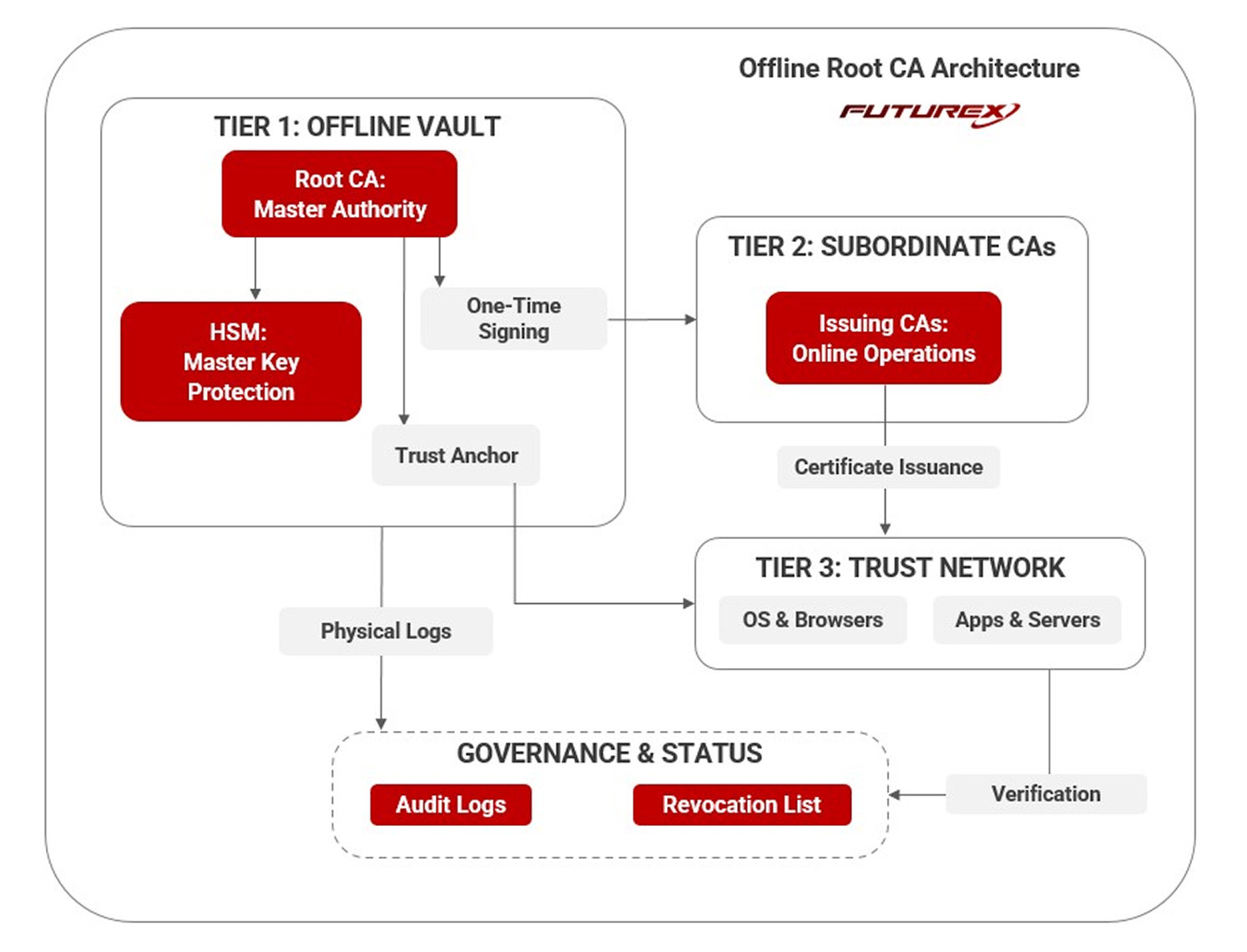
Offline Root CA Architecture
Offline Root CA integrates into enterprise PKI as the highest-trust signing layer and governs certificate hierarchy operations from an isolated control point.
A typical architecture includes:
- an offline Root CA environment isolated from network connections
- Futurex HSM infrastructure protecting the root private key and root signing operations
- subordinate CA and issuing CA layers that receive signed CA certificates from the offline root
- certificate policy and certificate signing request validation workflows
- trust distribution to operating systems, browsers, directories, servers, and relying systems
- audit, CRL, and revocation oversight for certificate status and governance
This model separates root trust from day-to-day issuance while preserving documented control over the full certificate hierarchy.
Integrations
Offline Root CA integrates with the systems that consume trust anchors, validate certificate chains, and support private PKI governance.
Enterprise Directory and Platform Environments
- Active Directory
- Windows Server
- Operating systems
- Web browsers and enterprise trust stores
Application and Validation Environments
- Web servers that rely on TLS certificates
- Email environments that use S/MIME certificates
- Client certificate authentication environments
- Service provider environments that depend on shared trust relationships
Certificate and Standards Workflows
- X.509 certificate environments
- Certificate signing request processing
- CRL distribution point workflows
- OCSP support for certificate status validation
- Command line and open-source PKI tooling
These integrations let organizations establish root trust across enterprise environments without spreading certificate authority control across disconnected systems.
Compliance Support
Offline Root CA helps teams maintain auditability, traceability, and governance at the highest level of the certificate hierarchy.
Futurex supports:
- documented root CA activity for audit review
- certificate policy enforcement records tied to certificate signing actions
- role-based permissions and multi-factor authentication for sensitive operations
- revocation status tracking and CRL distribution records
- evidence of root trust establishment, subordinate CA issuance, and certificate chain control
For regulated environments, that means clearer documentation of what root authority actions occurred, when they occurred, and which certificate hierarchy elements they affected.
Featured Resources
Offline Root CA FAQ
What is an offline root CA?
An offline root CA is the top certificate authority in a PKI hierarchy. It protects the root private key in an offline operating model and signs subordinate CA certificates that establish trust across the rest of the environment.
How does Futurex protect the root private key?
Futurex protects the root private key inside HSM-backed hardware with tamper-resistant controls, validated hardware boundaries, role-based permissions, and multi-factor authentication for sensitive operations.
How does it support subordinate CAs?
Futurex Offline Root CA signs intermediate CA and issuing CA certificates, validates certificate signing requests, and applies certificate policy controls so organizations can separate root trust from day-to-day issuance.
What standards and validation workflows does it support?
Futurex supports X.509 certificate environments, certificate signing request processing, CRL distribution points, OCSP-based validation workflows, and algorithm support for RSA, ECC, and emerging quantum-resistant standards.
How does it support compliance efforts?
Futurex provides audit trails, certificate detail tracking, access control records, policy enforcement documentation, and revocation status tracking for root CA operations and certificate hierarchy governance.
How is this different from an issuing CA?
An offline root CA sits at the top of the certificate hierarchy and signs subordinate CA certificates. An issuing CA handles day-to-day certificate issuance for users, devices, applications, or services. This page focuses on root trust and hierarchy control.
"Our ability to provide best in class solutions supported by independent auditors’ statements of compliance are crucial for all stakeholders – we were pleased to be able to partner with Futurex to provide industry leading cryptography solutions."
- Jude Heejun Han, Deputy Senior Manager of Software Engineering
Nautilus Hyosung
Protect the Root of Trust for Enterprise PKI
Root CA exposure creates outsized risk because it sits at the top of the certificate hierarchy. Futurex Offline Root CA provides offline operation, HSM-backed root key protection, subordinate CA signing control, and audit visibility for tighter PKI governance.