by
 Jason Way, VP Payment Cryptography Services
Last updated: September 15, 2026


Overview: Quantum computing does not break TR-34 as a protocol on its own, but it does pose long-term risks to RSA-based TR-34 implementations. ECC can improve security and efficiency today, while post-quantum cryptography should remain part of the longer-term cryptographic roadmap.
Table of Contents
TR-34 Powers Millions of Transactions - But Can It Keep Up
Why Are Banks Racing to Replace RSA with ECC in TR-34
The Hidden Complexity of an ECC Upgrade in Banking Security
From RSA to ECC: The Critical Steps for a Secure TR-34 Upgrade
The Future of ATM Security Hinges on This One Cryptographic Shift
Imagine a global network of ATMs and payment terminals quietly relying on encryption keys established years ago. These keys were injected using TR-34, a state-of-the-art cryptographic protocol introduced in 2012.
Fast-forward to today: the threat landscape has evolved, and quantum computing looms as a game-changer.
Experts warn that quantum advances pose a significant threat to current cryptographic infrastructure, prompting an urgent need to upgrade our defenses. One upgrade in particular has the financial industry on alert: combining TR-34 with Elliptic Curve Cryptography (ECC).
This post explains why this transition is critical, how it works technically, and what industry stakeholders should do to stay ahead.
TR-34 Powers Millions of Transactions - But Can It Keep Up?
What is TR-34?
TR-34 is a Technical Report (34) and describes the security method for transporting symmetric keys. It is commonly found in financial systems, as it underpins remote key loading for ATMs, point-of-sale devices, and other secure terminals. In simple terms, TR-34 provides a method for securely injecting encryption keys into devices in the field without manual loading.
How Does TR-34 Work?
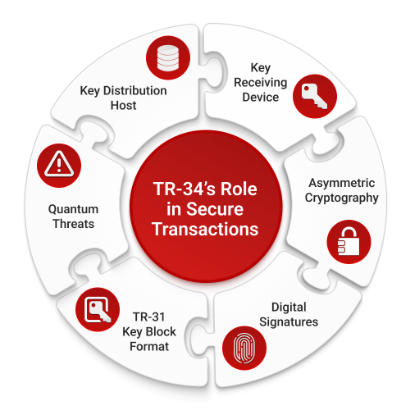
TR-34 is a certificate-based Remote Key Loading (RKL) protocol that relies on Public Key Infrastructure (PKI). It ensures that:
- The key distribution host (a bank’s secure server or HSM) and the key receiving device (ATM or POS terminal) authenticate each other.
- Symmetric encryption keys are securely exchanged using asymmetric cryptography (RSA-based public-private key pairs).
- Digital signatures ensure the integrity and authenticity of the key exchange.
Why Does TR-34 Matter?
Since its adoption, TR-34 has become widely used in retail banking systems for securely loading keys into ATMs and POS terminals. It works with the X9.143 key block format, which protects and packages operational keys during transit and storage.
TR-34’s robust security mechanisms include digital signatures, nonces, and certificate validation, making it a foundational component of secure payment transactions.
However, RSA-based cryptography, which TR-34 relies on, is beginning to show its age. With quantum computing threats emerging, an update is necessary.
Why Are Banks Racing to Replace RSA with ECC in TR-34?
Elliptic Curve Cryptography (ECC) provides a higher level of security than RSA but with much smaller key sizes and lower computational overhead.
The greatest benefit of ECC over RSA is that it allows AES keys to be wrapped more realistically, especially at higher security levels.
Current RSA limitations for a 128-bit AES key would require a 3,072-bit RSA key, so protecting a 256-bit AES key would require a substantially larger RSA key (e.g., 15k bits), which would not only be impractical, but computationally expensive and slow. ECC is therefore a preferred choice for modern payment systems.
- A 256-bit ECC key offers the same effective security as a 3,072-bit RSA key.
- Protecting a 256-bit AES Key would require a 15,360-bit RSA key, whereas ECC can protect it with a 512-bit ECC key.
- ECC requires less processing power and bandwidth, making it ideal for high-volume transactions.
- RSA’s growing key sizes impact performance, while ECC keeps cryptographic operations fast and efficient.
The Looming Quantum Threat
RSA’s security is based on the difficulty of factoring large prime numbers. Quantum computing, however, will eventually make this task trivial. ECC, though not quantum-proof, provides a stronger security foundation and a longer shelf life than RSA, though both algorithms are vulnerable to quantum computing in different ways.
The Case for ECC in TR-34
Increased use of TR-34 is under consideration by the X9F subcommittee, which is reviewing standardization methods to improve industry interoperability.
Updating TR-34 with ECC in mind would:
- Strengthen cryptographic security for key exchanges.
- Reduce computational costs and increase efficiency.
- Future-proof key management systems against emerging threats.
Yet, transitioning to ECC presents challenges.
The Hidden Complexity of an ECC Upgrade in Banking Security
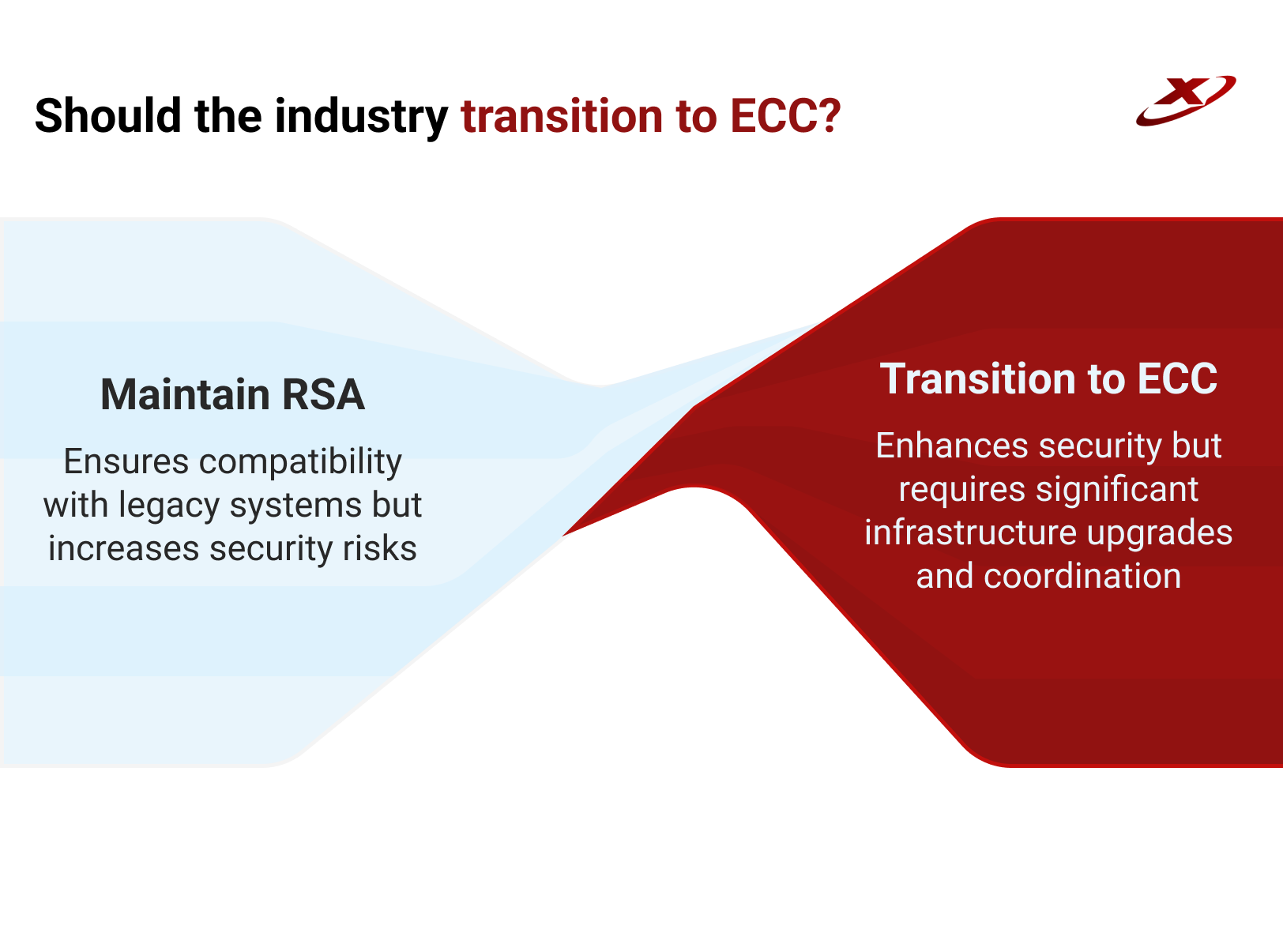
Updating TR-34 to support Elliptic Curve Cryptography (ECC) is significantly more complex than adding a new algorithm option. TR-34 was designed around an RSA-based trust and key transport model that is deeply integrated into payment device manufacturing, certificate management processes, host systems, and key injection workflows throughout the industry.
Key Challenges:
- Protocol Changes: TR-34 message structures, certificate handling, and key establishment mechanisms would need to be modified to accommodate ECC-based workflows.
- Ecosystem Adoption: Device manufacturers, key injection facilities, acquirers, processors, and host systems would all need to implement and validate support for the revised standard.
- Interoperability Requirements: Payment ecosystems depend on broad interoperability across organizations. Any transition would require coordination to ensure ECC-capable implementations can operate alongside existing TR-34 deployments.
- Certification and Compliance: Changes to cryptographic mechanisms often require updates to security evaluations, certifications, and operational procedures across multiple stakeholders.
From RSA to ECC: The Critical Steps for a Secure TR-34 Upgrade
The payments industry has a history of overcoming complex challenges through collaboration. The transition to ECC within TR-34 will require the same level of coordination.
Steps to Ensure a Smooth Transition:
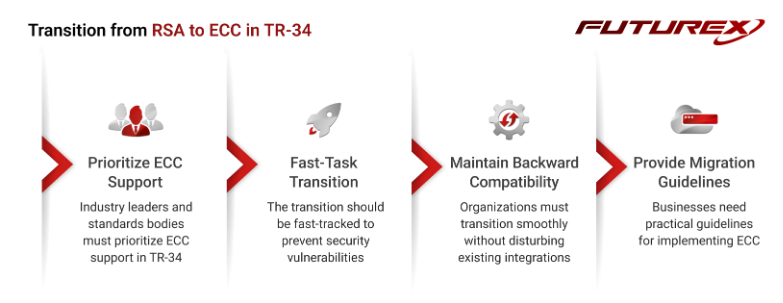
- Accelerate the Update:
- Industry leaders and standards bodies must prioritize ECC support in TR-34.
- The transition should be fast-tracked to prevent security vulnerabilities.
- Maintain Backward Compatibility:
- Organizations must transition smoothly from RSA to ECC without disrupting existing integrations.
- Dual-support models should be considered to ensure continued interoperability.
- Provide a Clear Migration Path:
- Businesses need practical guidelines for implementing ECC within their current infrastructure.
- A structured roadmap will minimize security risks and operational disruptions.
The Future of ATM Security Hinges on This One Cryptographic Shift
The payments industry has already proven its ability to adopt TR-34 at scale. Now, it must show the same commitment to updating it.
Accelerating the shift to ECC while maintaining compliance and interoperability can help the industry avoid emerging threats. Future-proofing Remote Key Delivery is not just a technical necessity. It is a strategic imperative.